
What does disabled mean?
Definitions for disabled
dis·abled
This dictionary definitions page includes all the possible meanings, example usage and translations of the word disabled.
Princeton's WordNet
disabled, handicappedadjective
people collectively who are crippled or otherwise physically handicapped
"technology to help the elderly and the disabled"
disabled, handicappedadjective
incapable of functioning as a consequence of injury or illness
GCIDE
disabledadjective
injured so as to be unable to function; as, disabled veterans.
disabledadjective
unable to function at normal capacity.
Wiktionary
disablednoun
Those who are disabled, regarded collectively or as a social group.
disabledadjective
Made incapable of use or action.
disabledadjective
Having a disability, especially physical.
disabledadjective
Legally disqualified.
Wikipedia
disabled
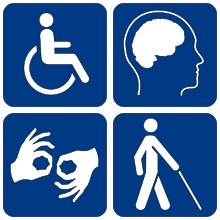
Disability is the experience of any condition that makes it more difficult for a person to do certain activities or have equitable access within a given society. Disabilities may be cognitive, developmental, intellectual, mental, physical, sensory, or a combination of multiple factors. Disabilities can be present from birth or can be acquired during a person's lifetime. Historically, disabilities have only been recognized based on a narrow set of criteria—however, disabilities are not binary and can be present in unique characteristics depending on the individual. A disability may be readily visible, or invisible in nature.
ChatGPT
disabled
Disabled refers to individuals who have physical, mental, intellectual, or sensory impairments, illnesses, or conditions which, combined with certain environmental or societal barriers, may limit their ability to perform day-to-day activities and/or participate fully and effectively in society on an equal level with others. Disabilities can be temporary or permanent, visible or invisible.
Webster Dictionary
Disabled
of Disable
Wikidata
Disabled
Disabled is a war poem by Wilfred Owen written in 1917. It expresses the tormented thoughts and recollections of a teenaged soldier in World War I who has lost his limbs in battle and is now confined, utterly helpless, to a wheelchair. The subject contrasts the living death he is now facing with the youthful pleasures he had enjoyed "before he threw away his knees"; he goes on to recall the impetuous and frivolous circumstances in which he had joined up to fight in the war. He also notes how the crowds that greeted his return were smaller and less enthusiastic than those who cheered his departure, and how women no longer look at him but at "the strong men who were whole".
Dictionary of Nautical Terms
disabled
To be placed hors de combat by the weather or an enemy.
British National Corpus
Spoken Corpus Frequency
Rank popularity for the word 'disabled' in Spoken Corpus Frequency: #3253
Written Corpus Frequency
Rank popularity for the word 'disabled' in Written Corpus Frequency: #2855
Adjectives Frequency
Rank popularity for the word 'disabled' in Adjectives Frequency: #427
Numerology
Chaldean Numerology
The numerical value of disabled in Chaldean Numerology is: 5
Pythagorean Numerology
The numerical value of disabled in Pythagorean Numerology is: 2
Examples of disabled in a Sentence
The white, the Hispanic, the black, the Arab, the Jew, the woman, the Native American, the small farmer, the businessperson, the environmentalist, the peace activist, the young, the old, the lesbian, the gay and the disabled make up the American quilt.
If you are a trader under SBI securities and are not able to sell your shares on some day then you can be sure that stock market will fall on that day. And if you are not able to buy share as price entry is disabled then the market will rise abruptly. Brokers are cheaters and their guardian is regulator
So much of the healing happens through camaraderie— through team and friendships, our belief is really that helping and healing disabled veterans is not a one-time event. We are mentors, healers and friends on their journey.
These are all really exciting initiatives that will make a huge difference to some people, but they are very expensive... they're not going to be available to the vast majority of disabled people.
I thought, ‘ Oh, she’s not moving fast enough. ’ So, I ran across the street and helped her to her truck, it was a disabled lady and she was walking out of her house.
Popularity rank by frequency of use
References
Translations for disabled
From our Multilingual Translation Dictionary
- معاقArabic
- инвалиден, инвалид, недъгав, изключенBulgarian
- minusvàlid, invàlidCatalan, Valencian
- postiženýCzech
- behindertGerman
- vammaiset, toimintakyvytön, käyttökelvoton, invalidit, vammainen, pätemätönFinnish
- invalide, handicapéFrench
- հաշմանդամArmenian
- disabilitato, disabile, per i disabiliItalian
- инвалид, хендикепирано лицеMacedonian
- gehandicapt, onklaar, invaliden, mindervalide, invalide, gehandicaptenDutch
- dezactivatRomanian
- неработоспособный, деактивированный, инвалидка, отключенный, нетрудоспособный, инвалид, инвалидныйRussian
Get even more translations for disabled »
Translation
Find a translation for the disabled definition in other languages:
Select another language:
- - Select -
- 简体中文 (Chinese - Simplified)
- 繁體中文 (Chinese - Traditional)
- Español (Spanish)
- Esperanto (Esperanto)
- 日本語 (Japanese)
- Português (Portuguese)
- Deutsch (German)
- العربية (Arabic)
- Français (French)
- Русский (Russian)
- ಕನ್ನಡ (Kannada)
- 한국어 (Korean)
- עברית (Hebrew)
- Gaeilge (Irish)
- Українська (Ukrainian)
- اردو (Urdu)
- Magyar (Hungarian)
- मानक हिन्दी (Hindi)
- Indonesia (Indonesian)
- Italiano (Italian)
- தமிழ் (Tamil)
- Türkçe (Turkish)
- తెలుగు (Telugu)
- ภาษาไทย (Thai)
- Tiếng Việt (Vietnamese)
- Čeština (Czech)
- Polski (Polish)
- Bahasa Indonesia (Indonesian)
- Românește (Romanian)
- Nederlands (Dutch)
- Ελληνικά (Greek)
- Latinum (Latin)
- Svenska (Swedish)
- Dansk (Danish)
- Suomi (Finnish)
- فارسی (Persian)
- ייִדיש (Yiddish)
- հայերեն (Armenian)
- Norsk (Norwegian)
- English (English)
Word of the Day
Would you like us to send you a FREE new word definition delivered to your inbox daily?
Citation
Use the citation below to add this definition to your bibliography:
Style:MLAChicagoAPA
"disabled." Definitions.net. STANDS4 LLC, 2024. Web. 28 Apr. 2024. <https://www.definitions.net/definition/disabled>.


Discuss these disabled definitions with the community:
Report Comment
We're doing our best to make sure our content is useful, accurate and safe.
If by any chance you spot an inappropriate comment while navigating through our website please use this form to let us know, and we'll take care of it shortly.
Attachment
You need to be logged in to favorite.
Log In