
What does galvanometer mean?
Definitions for galvanometer
ˌgæl vəˈnɒm ɪ tərgal·vanome·ter
This dictionary definitions page includes all the possible meanings, example usage and translations of the word galvanometer.
Princeton's WordNet
galvanometernoun
meter for detecting or comparing or measuring small electric currents
Wiktionary
galvanometernoun
A device used to indicate the presence and direction of a small electric current, especially used to detect a null or balanced condition in a bridge circuit.
Wikipedia
Galvanometer
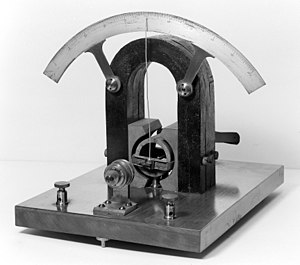
A galvanometer is an electromechanical measuring instrument for electric current. Early galvanometers were uncalibrated, but improved versions, called ammeters, were calibrated and could measure the flow of current more precisely. A galvanometer works by deflecting a pointer in response to an electric current flowing through a coil in a constant magnetic field. Galvanometers can be thought of as a kind of actuator. Galvanometers came from the observation, first noted by Hans Christian Ørsted in 1820, that a magnetic compass's needle deflects when near a wire having electric current. They were the first instruments used to detect and measure small amounts of current. André-Marie Ampère, who gave mathematical expression to Ørsted's discovery, named the instrument after the Italian electricity researcher Luigi Galvani, who in 1791 discovered the principle of the frog galvanoscope – that electric current would make the legs of a dead frog jerk. Galvanometers have been essential for the development of science and technology in many fields. For example, in the 1800s they enabled long-range communication through submarine cables, such as the earliest transatlantic telegraph cables, and were essential to discovering the electrical activity of the heart and brain, by their fine measurements of current. Galvanometers have also been used as the display components of other kinds of analog meters (e.g., light meters and VU meters), capturing the outputs of these meters' sensors. Today, the main type of galvanometer still in use is the D'Arsonval/Weston type.
ChatGPT
galvanometer
A galvanometer is a scientific instrument used for measuring electric current in a circuit. It works by producing a deflection of a pointer in response to electric current flowing through a coil in a magnetic field. Galvanometers can be used in various fields such as physics, engineering, and electronics for tasks ranging from lab experiments to monitoring the electrical systems in vehicles or buildings.
Webster Dictionary
Galvanometernoun
an instrument or apparatus for measuring the intensity of an electric current, usually by the deflection of a magnetic needle
Etymology: [Galvanic + -meter: cf. F. galvanomtre.]
Wikidata
Galvanometer
A galvanometer is a type of sensitive ammeter: an instrument for detecting electric current. It is an analog electromechanical actuator that produces a rotary deflection of some type of pointer in response to electric current flowing through its coil in a magnetic field. Galvanometers were the first instruments used to detect and measure electric currents. Sensitive galvanometers were used to detect signals from long submarine cables, and were used to discover the electrical activity of the heart and brain. Some galvanometers used a solid pointer on a scale to show measurements, other very sensitive types used a tiny mirror and a beam of light to provide mechanical amplification of tiny signals. Initially a laboratory instrument relying on the Earth's own magnetic field to provide restoring force for the pointer, galvanometers were developed into compact, rugged, sensitive portable instruments that were essential to the development of electrotechnology. A type of galvanometer that permanently recorded measurements was the chart recorder. The term has expanded to include uses of the same mechanism in recording, positioning, and servomechanism equipment.
The Standard Electrical Dictionary
Galvanometer
An instrument for measuring current strength and sometimes for measuring inferentially potential difference, depending on the action of a magnetic field established by the current, such action being exerted on a magnetic needle or its equivalent. A current passing through a conductor establishes circular lines of force. A magnetic needle placed in their field is acted on and tends to place itself parallel with the lines, in accordance with the principles of current induction. (See Induction, Electro-magnetic.) A common compass held near a conductor through which a current is passing tends to place itself at right angles to such conductor. For a maximum effect the conductor or the part nearest the needle should lie in the magnetic meridian. If at right angles thereto its action will only strengthen the directive force of the earth's induction or magnetic field, as the needle naturally points north and south. Such combination is virtually a galvanometer. A typical galvanometer comprises a flat coil of wire placed horizontally within which a magnetic needle is delicately poised, so as to be free to rotate with the least possible friction. The needle may be supported on a sharp point like a compass needle, or may be suspended by a long fine filament. It should be covered by a glass plate and box, or by a glass shade. Finally a graduated disc may be arranged to show the amount of deflection of the needle. In use the apparatus is turned about until the needle, as acted on by the earth's magnetic field, lies parallel to the direction of the coils of wire. On passing a current through the coil the needle is deflected, more or less, according to its strength. By using exceedingly fine wire, long enough to give high resistance, the instrument can be used for very high potentials, or is in condition for use in determining voltage. By using a coil of large wire and low resistance it can be employed in determining amperage. In either case the deflection is produced by the current. The needle is often placed above or below the coil so as only to receive a portion of its effect, enough for all practical purposes in the commoner class of instruments. The galvanometer was invented by Schweigger a short time after Oersted's discovery, q. v.
Matched Categories
Numerology
Chaldean Numerology
The numerical value of galvanometer in Chaldean Numerology is: 1
Pythagorean Numerology
The numerical value of galvanometer in Pythagorean Numerology is: 7
Popularity rank by frequency of use
References
Translations for galvanometer
From our Multilingual Translation Dictionary
Get even more translations for galvanometer »
Translation
Find a translation for the galvanometer definition in other languages:
Select another language:
- - Select -
- 简体中文 (Chinese - Simplified)
- 繁體中文 (Chinese - Traditional)
- Español (Spanish)
- Esperanto (Esperanto)
- 日本語 (Japanese)
- Português (Portuguese)
- Deutsch (German)
- العربية (Arabic)
- Français (French)
- Русский (Russian)
- ಕನ್ನಡ (Kannada)
- 한국어 (Korean)
- עברית (Hebrew)
- Gaeilge (Irish)
- Українська (Ukrainian)
- اردو (Urdu)
- Magyar (Hungarian)
- मानक हिन्दी (Hindi)
- Indonesia (Indonesian)
- Italiano (Italian)
- தமிழ் (Tamil)
- Türkçe (Turkish)
- తెలుగు (Telugu)
- ภาษาไทย (Thai)
- Tiếng Việt (Vietnamese)
- Čeština (Czech)
- Polski (Polish)
- Bahasa Indonesia (Indonesian)
- Românește (Romanian)
- Nederlands (Dutch)
- Ελληνικά (Greek)
- Latinum (Latin)
- Svenska (Swedish)
- Dansk (Danish)
- Suomi (Finnish)
- فارسی (Persian)
- ייִדיש (Yiddish)
- հայերեն (Armenian)
- Norsk (Norwegian)
- English (English)
Word of the Day
Would you like us to send you a FREE new word definition delivered to your inbox daily?
Citation
Use the citation below to add this definition to your bibliography:
Style:MLAChicagoAPA
"galvanometer." Definitions.net. STANDS4 LLC, 2024. Web. 28 Apr. 2024. <https://www.definitions.net/definition/galvanometer>.


Discuss these galvanometer definitions with the community:
Report Comment
We're doing our best to make sure our content is useful, accurate and safe.
If by any chance you spot an inappropriate comment while navigating through our website please use this form to let us know, and we'll take care of it shortly.
Attachment
You need to be logged in to favorite.
Log In