
What does epicycle mean?
Definitions for epicycle
ˈɛp əˌsaɪ kəlepicy·cle
This dictionary definitions page includes all the possible meanings, example usage and translations of the word epicycle.
Princeton's WordNet
epicyclenoun
a circle that rolls around (inside or outside) another circle; generates an epicycloid or hypocycloid
Wiktionary
epicyclenoun
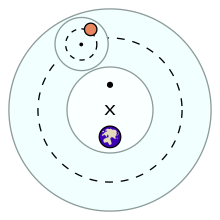
A small circle whose centre is on the circumference of a larger circle; in Ptolemaic astronomy it was seen as the basis of revolution of the "seven planets", given a fixed central Earth.
epicyclenoun
Any circle whose circumference rolls around that of another circle, thus creating a hypocycloid or epicycloid.
Etymology: From epicyclus, from ἐπίκυκλος, from ἐπί + κύκλος.
Samuel Johnson's Dictionary
Epicyclenoun
A little circle whose center is in the circumference of a greater; or a small orb, which, being fixed in the deferent of a planet, is carried along with its motion; and yet, with its own peculiar motion, carries the body of the planet fastened to it round about its proper center. John Harris
Etymology: ἐϖὶ and ϰύϰλος.
In regard of the epicycle, or lesser orb, wherein it moveth, the motion of the moon is various and unequal. Brown.
Gird the sphere
With centric and eccentric, scribbl’d o’er;
Cycle and epicycle, orb in orb. John Milton, Paradise Lost, b. viii.
Wikipedia
epicycle
In the Hipparchian, Ptolemaic, and Copernican systems of astronomy, the epicycle (from Ancient Greek ἐπίκυκλος (epíkuklos) 'upon the circle', meaning "circle moving on another circle") was a geometric model used to explain the variations in speed and direction of the apparent motion of the Moon, Sun, and planets. In particular it explained the apparent retrograde motion of the five planets known at the time. Secondarily, it also explained changes in the apparent distances of the planets from the Earth. It was first proposed by Apollonius of Perga at the end of the 3rd century BC. It was developed by Apollonius of Perga and Hipparchus of Rhodes, who used it extensively, during the 2nd century BC, then formalized and extensively used by Ptolemy in his 2nd century AD astronomical treatise the Almagest. Epicyclical motion is used in the Antikythera mechanism, an ancient Greek astronomical device for compensating for the elliptical orbit of the Moon, moving faster at perigee and slower at apogee than circular orbits would, using four gears, two of them engaged in an eccentric way that quite closely approximates Kepler's second law. Epicycles worked very well and were highly accurate, because, as Fourier analysis later showed, any smooth curve can be approximated to arbitrary accuracy with a sufficient number of epicycles. However, they fell out of favor with the discovery that planetary motions were largely elliptical from a heliocentric frame of reference, which led to the discovery that gravity obeying a simple inverse square law could better explain all planetary motions.
ChatGPT
epicycle
An epicycle is a small circle, the center of which moves around the circumference of a larger circle. This concept was primarily used in the geocentric model of planetary motion proposed by the ancient Greek astronomer, Ptolemy, and others to explain the apparent irregular movements of celestial bodies.
Webster Dictionary
Epicyclenoun
a circle, whose center moves round in the circumference of a greater circle; or a small circle, whose center, being fixed in the deferent of a planet, is carried along with the deferent, and yet, by its own peculiar motion, carries the body of the planet fastened to it round its proper center
Epicyclenoun
a circle which rolls on the circumference of another circle, either externally or internally
Etymology: [L. epicyclus, Gr. ; 'epi` upon + circle. See Cycle.]
Chambers 20th Century Dictionary
Epicycle
ep′i-sī-kl, n. a circle having its centre on the circumference of a greater circle on which it moves.—adj. Epicy′clic.—n. Epicy′cloid, a curve described by every point in the plane of a circle moving on the convex circumference of another circle.—adj. Epicycloi′dal. [Gr. epi, upon, kyklos, a circle.]
The Nuttall Encyclopedia
Epicycle
an expression used in the Ptolemaic (q. v.) system of astronomy; the old belief that the celestial bodies moved in perfect circles round the earth was found to be inadequate to explain the varying position of the planets, a difficulty which led Ptolemy to invent his theory of epicycles, which was to the effect that each planet revolved round a centre of its own, greater or less, but that all these centres themselves moved in procession round the earth, a theory which fell to pieces before the investigations of Kepler and Newton.
Matched Categories
Numerology
Chaldean Numerology
The numerical value of epicycle in Chaldean Numerology is: 2
Pythagorean Numerology
The numerical value of epicycle in Pythagorean Numerology is: 6
References
Translations for epicycle
From our Multilingual Translation Dictionary
- епицикълBulgarian
- epicicleCatalan, Valencian
- epicyklCzech
- epicykelDanish
- EpizykelGerman
- epicicloSpanish
- episykliFinnish
- épicycleFrench
- far-chiarkylManx
- אפיציקלHebrew
- epicikloIdo
- aukahringur, hjáhringurIcelandic
- epicicloItalian
- അധിചക്രംMalayalam
- epicykelsDutch
- episyklusNorwegian
- epicicloPortuguese
- эпициклRussian
- epicyklusSlovak
- epicykelSwedish
Get even more translations for epicycle »
Translation
Find a translation for the epicycle definition in other languages:
Select another language:
- - Select -
- 简体中文 (Chinese - Simplified)
- 繁體中文 (Chinese - Traditional)
- Español (Spanish)
- Esperanto (Esperanto)
- 日本語 (Japanese)
- Português (Portuguese)
- Deutsch (German)
- العربية (Arabic)
- Français (French)
- Русский (Russian)
- ಕನ್ನಡ (Kannada)
- 한국어 (Korean)
- עברית (Hebrew)
- Gaeilge (Irish)
- Українська (Ukrainian)
- اردو (Urdu)
- Magyar (Hungarian)
- मानक हिन्दी (Hindi)
- Indonesia (Indonesian)
- Italiano (Italian)
- தமிழ் (Tamil)
- Türkçe (Turkish)
- తెలుగు (Telugu)
- ภาษาไทย (Thai)
- Tiếng Việt (Vietnamese)
- Čeština (Czech)
- Polski (Polish)
- Bahasa Indonesia (Indonesian)
- Românește (Romanian)
- Nederlands (Dutch)
- Ελληνικά (Greek)
- Latinum (Latin)
- Svenska (Swedish)
- Dansk (Danish)
- Suomi (Finnish)
- فارسی (Persian)
- ייִדיש (Yiddish)
- հայերեն (Armenian)
- Norsk (Norwegian)
- English (English)
Word of the Day
Would you like us to send you a FREE new word definition delivered to your inbox daily?
Citation
Use the citation below to add this definition to your bibliography:
Style:MLAChicagoAPA
"epicycle." Definitions.net. STANDS4 LLC, 2024. Web. 26 Apr. 2024. <https://www.definitions.net/definition/epicycle>.


Discuss these epicycle definitions with the community:
Report Comment
We're doing our best to make sure our content is useful, accurate and safe.
If by any chance you spot an inappropriate comment while navigating through our website please use this form to let us know, and we'll take care of it shortly.
Attachment
You need to be logged in to favorite.
Log In