
What does down syndrome mean?
Definitions for down syndrome
down syn·drome
This dictionary definitions page includes all the possible meanings, example usage and translations of the word down syndrome.
Princeton's WordNet
mongolism, mongolianism, Down's syndrome, Down syndrome, trisomy 21noun
a congenital disorder caused by having an extra 21st chromosome; results in a flat face and short stature and mental retardation
Wiktionary
Down syndromenoun
Condition caused by a chromosomal excess, whereby the patients bear a certain resemblance to the Mongoloid race, such as a small head and tilted eyelids.
Etymology: Named after John L.H. Langdon-Down (1828-1896), an English physician who described it in the late 1800s. The term was first used in 1961.
Wikipedia
Down syndrome
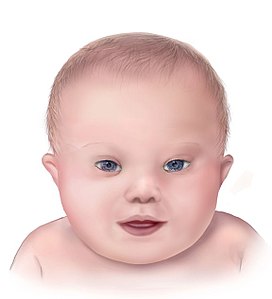
Down syndrome or Down's syndrome, also known as trisomy 21, is a genetic disorder caused by the presence of all or part of a third copy of chromosome 21. It is usually associated with physical growth delays, mild to moderate intellectual disability, and characteristic facial features. The average IQ of a young adult with Down syndrome is 50, equivalent to the mental ability of an eight- or nine-year-old child, but this can vary widely.The parents of the affected individual are usually genetically normal. The probability increases from less than 0.1% in 20-year-old mothers to 3% in those of age 45. The extra chromosome is believed to occur by chance, with no known behavioral activity or environmental factor that changes the probability. Down syndrome can be identified during pregnancy by prenatal screening followed by diagnostic testing or after birth by direct observation and genetic testing. Since the introduction of screening, Down syndrome pregnancies are often aborted (rates varying from 50%-85% depending on maternal age, gestational age, and maternal race/ethnicity).There is no cure for Down syndrome. Education and proper care have been shown to improve quality of life. Some children with Down syndrome are educated in typical school classes, while others require more specialized education. Some individuals with Down syndrome graduate from high school, and a few attend post-secondary education. In adulthood, about 20% in the United States do paid work in some capacity, with many requiring a sheltered work environment. Support in financial and legal matters is often needed. Life expectancy is around 50 to 60 years in the developed world with proper health care. Regular screening for health problems common in Down syndrome is recommended throughout the person's life.Down syndrome is one of the most common chromosome abnormalities in humans. It occurs in about 1 in 1,000 babies born each year. In 2015, Down syndrome was present in 5.4 million individuals globally and resulted in 27,000 deaths, down from 43,000 deaths in 1990. It is named after British doctor John Langdon Down, who fully described the syndrome in 1866. Some aspects of the condition were described earlier by French psychiatrist Jean-Étienne Dominique Esquirol in 1838 and French physician Édouard Séguin in 1844. The genetic cause of Down syndrome was discovered in 1959.
ChatGPT
down syndrome
Down Syndrome, also known as trisomy 21, is a genetic disorder caused by the presence of an extra 21st chromosome. This additional chromosome results in a range of physical characteristics, intellectual and developmental issues. Features may include mild to moderate intellectual disability, delayed developmental milestones, distinctive facial features, and an increased risk of certain medical conditions. It impacts the person's physical growth and their ability to learn and develop mentally. The severity of these symptoms varies from person to person.
Wikidata
Down syndrome
Down syndrome or Down's syndrome, also known as trisomy 21, is a genetic disorder caused by the presence of all or part of a third copy of chromosome 21. Down syndrome is the most common chromosome abnormality in humans. It is typically associated with a delay in cognitive ability and physical growth, and a particular set of facial characteristics. The average IQ of young adults with Down syndrome is around 50, whereas young adults without the condition typically have an IQ of 100. A large proportion of individuals with Down syndrome have a severe degree of intellectual disability. Down syndrome is named after John Langdon Down, the British physician who described the syndrome in 1866. The condition was clinically described earlier by Jean Etienne Dominique Esquirol in 1838 and Edouard Seguin in 1844. Down syndrome was identified as a chromosome 21 trisomy by Dr. Jérôme Lejeune in 1959. Down syndrome can be identified in a newborn by direct observation or in a fetus by prenatal screening. Pregnancies with this diagnosis are often terminated. The CDC estimates that about one of every 691 babies born in the United States each year is born with Down syndrome.
U.S. National Library of Medicine
Down Syndrome
A chromosome disorder associated either with an extra chromosome 21 or an effective trisomy for chromosome 21. Clinical manifestations include hypotonia, short stature, brachycephaly, upslanting palpebral fissures, epicanthus, Brushfield spots on the iris, protruding tongue, small ears, short, broad hands, fifth finger clinodactyly, Simian crease, and moderate to severe MENTAL RETARDATION. Cardiac and gastrointestinal malformations, a marked increase in the incidence of LEUKEMIA, and the early onset of ALZHEIMER DISEASE are also associated with this condition. Pathologic features include the development of NEUROFIBRILLARY TANGLES in neurons and the deposition of AMYLOID BETA-PROTEIN, similar to the pathology of ALZHEIMER DISEASE. (Menkes, Textbook of Child Neurology, 5th ed, p213)
Matched Categories
Numerology
Chaldean Numerology
The numerical value of down syndrome in Chaldean Numerology is: 8
Pythagorean Numerology
The numerical value of down syndrome in Pythagorean Numerology is: 7
Examples of down syndrome in a Sentence
I think it is time people realized that people with Down syndrome can be beautiful and should be celebrated, she is not insecure in the least bit, but I have made a point of never letting anyone be critical of her and telling her every day how amazing, funny, smart, beautiful, wonderful she is.
Kids with Down syndrome are already at a disadvantage, as far as speech is concerned, they already have speech delays — so to add hearing loss to that, the odds are stacked against Ashley Davis. Tonya Nussbaum, an audiologist at Children’s Healthcare of Atlanta, said Sarah Grace Davis has conductive hearing loss stemming from structural problems with Sarah Grace Davis ear. The hearing nerve is working fine.
It’s very important to us that we include the individuals with Down syndrome in their care, if you’re doing that, you have to take your time. You have to explain things. You have to let them process. You have to let them answer. All of that takes more time.
From that first visit, we dreaded our appointments. The most difficult time in my life was made nearly unbearable because you never told me the truth. My child was perfect, i’m not angry. I’m not bitter. I’m just really sad. I’m sad the tiny beating hearts you see every day don’t fill you with a perpetual awe. I’m sad the intricate details and the miracle of those sweet little fingers and toes, lungs and eyes and ears don’t always give you pause. I’m said you were so wrong to say a baby with Down syndrome would decrease our quality of life. And I’m heartbroken you might have said that to a mommy even today. But I’m mostly sad you’ll never have the privilege of knowing my daughter, Emersyn.
There is no road map with Chris, a Down syndrome athlete has never even attempted a 17-hour race that involved a bike, a swim, and a run, so we didn't know what to expect.
Translations for down syndrome
From our Multilingual Translation Dictionary
Get even more translations for down syndrome »
Translation
Find a translation for the down syndrome definition in other languages:
Select another language:
- - Select -
- 简体中文 (Chinese - Simplified)
- 繁體中文 (Chinese - Traditional)
- Español (Spanish)
- Esperanto (Esperanto)
- 日本語 (Japanese)
- Português (Portuguese)
- Deutsch (German)
- العربية (Arabic)
- Français (French)
- Русский (Russian)
- ಕನ್ನಡ (Kannada)
- 한국어 (Korean)
- עברית (Hebrew)
- Gaeilge (Irish)
- Українська (Ukrainian)
- اردو (Urdu)
- Magyar (Hungarian)
- मानक हिन्दी (Hindi)
- Indonesia (Indonesian)
- Italiano (Italian)
- தமிழ் (Tamil)
- Türkçe (Turkish)
- తెలుగు (Telugu)
- ภาษาไทย (Thai)
- Tiếng Việt (Vietnamese)
- Čeština (Czech)
- Polski (Polish)
- Bahasa Indonesia (Indonesian)
- Românește (Romanian)
- Nederlands (Dutch)
- Ελληνικά (Greek)
- Latinum (Latin)
- Svenska (Swedish)
- Dansk (Danish)
- Suomi (Finnish)
- فارسی (Persian)
- ייִדיש (Yiddish)
- հայերեն (Armenian)
- Norsk (Norwegian)
- English (English)
Word of the Day
Would you like us to send you a FREE new word definition delivered to your inbox daily?
Citation
Use the citation below to add this definition to your bibliography:
Style:MLAChicagoAPA
"down syndrome." Definitions.net. STANDS4 LLC, 2024. Web. 26 Apr. 2024. <https://www.definitions.net/definition/down+syndrome>.


Discuss these down syndrome definitions with the community:
Report Comment
We're doing our best to make sure our content is useful, accurate and safe.
If by any chance you spot an inappropriate comment while navigating through our website please use this form to let us know, and we'll take care of it shortly.
Attachment
You need to be logged in to favorite.
Log In