
What does carbon mean?
Definitions for carbon
ˈkɑr bəncar·bon
This dictionary definitions page includes all the possible meanings, example usage and translations of the word carbon.
Princeton's WordNet
carbon, C, atomic number 6noun
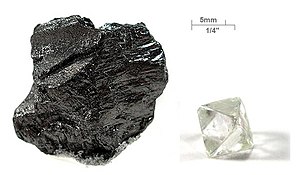
an abundant nonmetallic tetravalent element occurring in three allotropic forms: amorphous carbon and graphite and diamond; occurs in all organic compounds
carbon paper, carbonnoun
a thin paper coated on one side with a dark waxy substance (often containing carbon); used to transfer characters from the original to an under sheet of paper
carbon, carbon copynoun
a copy made with carbon paper
GCIDE
Carbonnoun
a sheet of carbon paper.
Carbonnoun
a carbon copy.
Wiktionary
carbonnoun
The chemical element (symbol C) with an atomic number of 6.
carbonnoun
A sheet of carbon paper.
Make sure the carbon is facing the second sheet of paper, before rolling it into the typewriter.
carbonnoun
A carbon copy.
carbonnoun
A fossil fuel that is made of impure carbon such as coal or charcoal.
carbonnoun
Carbon dioxide, in the context of global warming and climate change.
Etymology: from carbo.
Wikipedia
Carbon
Carbon (from Latin carbo 'coal') is a chemical element with the symbol C and atomic number 6. It is nonmetallic and tetravalent—its atom making four electrons available to form covalent chemical bonds. It belongs to group 14 of the periodic table. Carbon makes up about 0.025 percent of Earth's crust. Three isotopes occur naturally, 12C and 13C being stable, while 14C is a radionuclide, decaying with a half-life of about 5,730 years. Carbon is one of the few elements known since antiquity.Carbon is the 15th most abundant element in the Earth's crust, and the fourth most abundant element in the universe by mass after hydrogen, helium, and oxygen. Carbon's abundance, its unique diversity of organic compounds, and its unusual ability to form polymers at the temperatures commonly encountered on Earth, enables this element to serve as a common element of all known life. It is the second most abundant element in the human body by mass (about 18.5%) after oxygen.The atoms of carbon can bond together in diverse ways, resulting in various allotropes of carbon. Well-known allotropes include graphite, diamond, amorphous carbon and fullerenes. The physical properties of carbon vary widely with the allotropic form. For example, graphite is opaque and black while diamond is highly transparent. Graphite is soft enough to form a streak on paper (hence its name, from the Greek verb "γράφειν" which means "to write"), while diamond is the hardest naturally occurring material known. Graphite is a good electrical conductor while diamond has a low electrical conductivity. Under normal conditions, diamond, carbon nanotubes, and graphene have the highest thermal conductivities of all known materials. All carbon allotropes are solids under normal conditions, with graphite being the most thermodynamically stable form at standard temperature and pressure. They are chemically resistant and require high temperature to react even with oxygen. The most common oxidation state of carbon in inorganic compounds is +4, while +2 is found in carbon monoxide and transition metal carbonyl complexes. The largest sources of inorganic carbon are limestones, dolomites and carbon dioxide, but significant quantities occur in organic deposits of coal, peat, oil, and methane clathrates. Carbon forms a vast number of compounds, with almost ten million compounds described to date, and yet that number is but a fraction of the number of theoretically possible compounds under standard conditions.
ChatGPT
carbon
Carbon is a chemical element with the symbol C and atomic number 6. It is non-metallic, tetravalent, and makes up only about 0.025 percent of the earth's crust, yet it is the fourth most abundant element in the universe by mass. Carbon is present in all forms of life and plays a key role in the life processes of all living things. It is also a part of various inorganic compounds such as carbon dioxide and carbonates and is a major component of fossil fuels. Carbon is known for its ability to form stable bonds with many elements, including itself, resulting in a vast number of compounds with diverse properties.
Webster Dictionary
Carbonnoun
an elementary substance, not metallic in its nature, which is present in all organic compounds. Atomic weight 11.97. Symbol C. it is combustible, and forms the base of lampblack and charcoal, and enters largely into mineral coals. In its pure crystallized state it constitutes the diamond, the hardest of known substances, occuring in monometric crystals like the octahedron, etc. Another modification is graphite, or blacklead, and in this it is soft, and occurs in hexagonal prisms or tables. When united with oxygen it forms carbon dioxide, commonly called carbonic acid, or carbonic oxide, according to the proportions of the oxygen; when united with hydrogen, it forms various compounds called hydrocarbons. Compare Diamond, and Graphite
Etymology: [F. carbone, fr. L. carbo coal; cf. Skr. r to cook.]
Wikidata
Carbon
Carbon is the chemical element with symbol C and atomic number 6. As a member of group 14 on the periodic table, it is nonmetallic and tetravalent—making four electrons available to form covalent chemical bonds. There are three naturally occurring isotopes, with ¹²C and ¹³C being stable, while 14C is radioactive, decaying with a half-life of about 5,730 years. Carbon is one of the few elements known since antiquity. There are several allotropes of carbon of which the best known are graphite, diamond, and amorphous carbon. The physical properties of carbon vary widely with the allotropic form. For example, diamond is highly transparent, while graphite is opaque and black. Diamond is the hardest naturally-occurring material known, while graphite is soft enough to form a streak on paper. Diamond has a very low electrical conductivity, while graphite is a very good conductor. Under normal conditions, diamond, carbon nanotube and graphene have the highest thermal conductivities of all known materials. All carbon allotropes are solids under normal conditions with graphite being the most thermodynamically stable form. They are chemically resistant and require high temperature to react even with oxygen. The most common oxidation state of carbon in inorganic compounds is +4, while +2 is found in carbon monoxide and other transition metal carbonyl complexes. The largest sources of inorganic carbon are limestones, dolomites and carbon dioxide, but significant quantities occur in organic deposits of coal, peat, oil and methane clathrates. Carbon forms more compounds than any other element, with almost ten million pure organic compounds described to date, which in turn are a tiny fraction of such compounds that are theoretically possible under standard conditions.
Chambers 20th Century Dictionary
Carbon
kär′bon, n. an elementary substance, widely diffused, of which pure charcoal is an example.—n. Car′bide, a compound of carbon with a metal, formerly called Car′buret.—adjs. Carbonā′ceous, Carbon′ic, pertaining to or composed of carbon.—n. Car′bonate, a salt formed by the union of carbonic acid with a base.—adjs. Car′bonated, combined or impregnated with carbonic acid; Carbonif′erous, producing carbon or coal.—n. Carbonisā′tion—v.t. Car′bonise, to make into carbon.—Carbonic acid, an acid formed of carbon and oxygen, generally gaseous, and evolved by respiration and combustion. [Fr. carbone—L. carbon-em, coal.]
U.S. National Library of Medicine
Carbon
A nonmetallic element with atomic symbol C, atomic number 6, and atomic weight 12.011. It may occur as several different allotropes including DIAMOND; CHARCOAL; and GRAPHITE; and as SOOT from incompletely burned fuel.
The Standard Electrical Dictionary
Carbon
(a) One of the elements; atomic weight, 12. It exists in three allotropic modifications, charcoal, graphite and diamond. In the graphitic form it is used as an electric current conductor, as in batteries and for arc lamp, electrodes and incandescent lamp filaments. It is the only substance which conducts electricity and which cannot be melted with comparative ease by increase of current. (See Resistance.) (b) The carbon plate of a battery or rod of an arc lamp. To secure greater conductivity in lamp carbons, they are sometimes plated with nickel or with copper. (c) v. To place carbons in arc lamps. This has generally to be done once in twenty-four hours, unless the period of burning is very short.
Military Dictionary and Gazetteer
carbon
See Charcoal.
Suggested Resources
carbon
Song lyrics by carbon -- Explore a large variety of song lyrics performed by carbon on the Lyrics.com website.
Surnames Frequency by Census Records
CARBON
According to the U.S. Census Bureau, Carbon is ranked #27514 in terms of the most common surnames in America.
The Carbon surname appeared 876 times in the 2010 census and if you were to sample 100,000 people in the United States, approximately 0 would have the surname Carbon.
58.9% or 516 total occurrences were White.
24% or 211 total occurrences were Black.
8.5% or 75 total occurrences were of Hispanic origin.
5.8% or 51 total occurrences were Asian.
1.8% or 16 total occurrences were of two or more races.
0.8% or 7 total occurrences were American Indian or Alaskan Native.
British National Corpus
Spoken Corpus Frequency
Rank popularity for the word 'carbon' in Spoken Corpus Frequency: #4022
Written Corpus Frequency
Rank popularity for the word 'carbon' in Written Corpus Frequency: #2527
Nouns Frequency
Rank popularity for the word 'carbon' in Nouns Frequency: #1573
Anagrams for carbon »
corban
bracon
Numerology
Chaldean Numerology
The numerical value of carbon in Chaldean Numerology is: 2
Pythagorean Numerology
The numerical value of carbon in Pythagorean Numerology is: 8
Examples of carbon in a Sentence
On the environmental level, Senegal has never had a project on this scale, this farm will avoid ... 300,000 tonnes of carbon emissions.
With an ‘ interstate for electrons ’, renewable energy could be delivered anywhere in the country while emissions plummet, an HVDC grid would create a national electricity market in which all types of generation, including low-carbon sources, compete on a cost basis. The surprise was how dominant wind and solar could be.
Equinor is doing some great stuff, particularly on (Scope 1 and 2 emissions), but I'm not sure a pledge to halve carbon intensity by 2050 does it any more.
You're not actually removing the emissions that have been created by that plane, the plane will have burned that fuel, and the carbon has been released into the atmosphere.
The first immediate task for all parts of the industry is reducing the carbon footprint of their own operations.
Popularity rank by frequency of use
References
Translations for carbon
From our Multilingual Translation Dictionary
- koolstofAfrikaans
- كربونArabic
- karbonAzerbaijani
- вугляро́дBelarusian
- инди́го, въглеро́ден диокси́д, въглеро́д, ко́пие, въ́глищаBulgarian
- অঙ্গারBengali
- karbon, glaouBreton
- carbó, carboniCatalan, Valencian
- carboniuCorsican
- kopírák, uhlí, uhlíkCzech
- carbon, ulwynWelsh
- karbon, koks, karbonpapir, carbon, kul, kulstof, trækul, kalkerpapir, stenkulDanish
- Kohlenstoff, Kohle, KohlendioxidGerman
- κοινοποίηση, καρμπόν, κάρβουνο, διοξείδιο, άνθρακαςGreek
- karbonoEsperanto
- carbón, carbonoSpanish
- süsinik, süsi, süsinikdioksiid, süsihappegaasEstonian
- karbonoaBasque
- کربنPersian
- hiilidioksidi, hiili, kalkkeripaperi, kopsuFinnish
- kolevniFaroese
- carbone, charbonFrench
- koalstofWestern Frisian
- carbónIrish
- gualan, gualScottish Gaelic
- carbonoGalician
- કાર્બનGujarati
- carboanManx
- פחמןHebrew
- प्रांगारHindi
- kabònHaitian Creole
- indigómásolat, másolat, szén, indigó, másolópapírHungarian
- ածխածինArmenian
- carbonInterlingua
- karbonIndonesian
- karboIdo
- kolefni, kolefnis pappírIcelandic
- carbonioItalian
- ᐸᐅᖅInuktitut
- カーボンコピー, 炭, 石炭, 炭素Japanese
- karbonJavanese
- ნახშირბადიGeorgian
- көмиртекKazakh
- ការបោនKhmer
- ಇಂಗಾಲKannada
- 탄소, 카아본지Korean
- karbonKurdish
- karbonCornish
- carbonium, carbo, ipsumLatin
- KuelestoffLuxembourgish, Letzeburgesch
- koolstofLimburgish, Limburgan, Limburger
- kaboniLingala
- anglisLithuanian
- ogle, ogleklisLatvian
- waroMāori
- јаглеродMacedonian
- കാര്ബണ്Malayalam
- нүүрстөрөгчMongolian
- कार्बनMarathi
- karbon, arangMalay
- karbonjuMaltese
- doorslag, kool, koolstof, koolstofdioxideDutch
- karbonNorwegian Nynorsk
- karbon, kullsyre, blåpapir, blåkopi, kull, kulldioksidNorwegian
- káábinNavajo, Navaho
- carbòniOccitan
- ଅଙ୍ଗାରକOriya
- ਕਾਰਬਨPanjabi, Punjabi
- węgiel, kalka, dwutlenek węglaPolish
- papel-carbono, carbono, carvãoPortuguese
- k'illimsayaqQuechua
- cărbune, carbonRomanian
- углекислота́, у́голь, углеки́слый газ, углеро́д, двуо́кись углеро́да, копи́ркаRussian
- कौकिलीयSanskrit
- ugalj, ćumur, karbon, ugljik, угљеник, угљик, ugljenik, угаљ, ћумурSerbo-Croatian
- uhlíkSlovak
- ogljikSlovene
- karboniAlbanian
- karbonSundanese
- kol, karbonpapper, genomslagskopia, koldioxidSwedish
- kaboniSwahili
- கரிமம், கரிமக் காகிதம், கரிTamil
- కార్బన్, అచ్చు కాగితంTelugu
- карбонTajik
- คาร์บอนThai
- karbonTagalog
- karbon, kömürTurkish
- вуглецьUkrainian
- uglerodUzbek
- thán khí, cacbon, cacbon điôxít, giấy than, than, anhiđrít cacbonic, than củi, khí cacbonic, điôxít cacbonVietnamese
- karbinVolapük
- carboneWalloon
- קוילנשטאףYiddish
- 碳Chinese
Get even more translations for carbon »
Translation
Find a translation for the carbon definition in other languages:
Select another language:
- - Select -
- 简体中文 (Chinese - Simplified)
- 繁體中文 (Chinese - Traditional)
- Español (Spanish)
- Esperanto (Esperanto)
- 日本語 (Japanese)
- Português (Portuguese)
- Deutsch (German)
- العربية (Arabic)
- Français (French)
- Русский (Russian)
- ಕನ್ನಡ (Kannada)
- 한국어 (Korean)
- עברית (Hebrew)
- Gaeilge (Irish)
- Українська (Ukrainian)
- اردو (Urdu)
- Magyar (Hungarian)
- मानक हिन्दी (Hindi)
- Indonesia (Indonesian)
- Italiano (Italian)
- தமிழ் (Tamil)
- Türkçe (Turkish)
- తెలుగు (Telugu)
- ภาษาไทย (Thai)
- Tiếng Việt (Vietnamese)
- Čeština (Czech)
- Polski (Polish)
- Bahasa Indonesia (Indonesian)
- Românește (Romanian)
- Nederlands (Dutch)
- Ελληνικά (Greek)
- Latinum (Latin)
- Svenska (Swedish)
- Dansk (Danish)
- Suomi (Finnish)
- فارسی (Persian)
- ייִדיש (Yiddish)
- հայերեն (Armenian)
- Norsk (Norwegian)
- English (English)
Word of the Day
Would you like us to send you a FREE new word definition delivered to your inbox daily?
Citation
Use the citation below to add this definition to your bibliography:
Style:MLAChicagoAPA
"carbon." Definitions.net. STANDS4 LLC, 2024. Web. 28 Apr. 2024. <https://www.definitions.net/definition/carbon>.


Discuss these carbon definitions with the community:
Report Comment
We're doing our best to make sure our content is useful, accurate and safe.
If by any chance you spot an inappropriate comment while navigating through our website please use this form to let us know, and we'll take care of it shortly.
Attachment
You need to be logged in to favorite.
Log In