
What does Russia mean?
Definitions for Russia
ˈrʌʃ ərus·si·a
This dictionary definitions page includes all the possible meanings, example usage and translations of the word Russia.
Princeton's WordNet
Soviet Union, Russia, Union of Soviet Socialist Republics, USSRnoun
a former communist country in eastern Europe and northern Asia; established in 1922; included Russia and 14 other soviet socialist republics (Ukraine and Byelorussia and others); officially dissolved 31 December 1991
Soviet Russia, Russia, Russian Soviet Federated Socialist Republicnoun
formerly the largest Soviet Socialist Republic in the USSR occupying eastern Europe and northern Asia
Russianoun
a former empire in eastern Europe and northern Asia created in the 14th century with Moscow as the capital; powerful in the 17th and 18th centuries under Peter the Great and Catherine the Great when Saint Petersburg was the capital; overthrown by revolution in 1917
Russia, Russian Federationnoun
a federation in northeastern Europe and northern Asia; formerly Soviet Russia; since 1991 an independent state
Wiktionary
Russianoun
A country in Eastern Europe and Northern Asia. The Country extends from the Gulf of Finland to the Pacific Ocean, and was part of the USSR from 1922 to 1991. Co-official name - Russian Federation, formerly the Russian Soviet Federative Socialist Republic (RSFSR), Capital and largest city Moscow
Russianoun
The Union of Soviet Socialist Republics (a very common name, although more formally Russia, the RSFSR, was one of several constituent republics of the USSR).
Russianoun
The Russian Empire.
Russianoun
Rus, the medieval East Slavic state.
Wikipedia
Russia
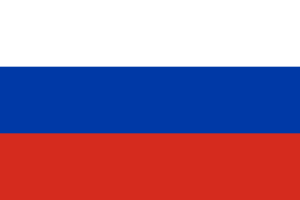
Russia (Russian: Росси́я, tr. Rossiya, IPA: [rɐˈsʲijə]), officially the Russian Federation (Russian: Росси́йская Федера́ция, tr. Rossiyskaya Federatsiya, IPA: [rɐˈsʲijskəjə fʲɪdʲɪˈratsɨjə]), is a transcontinental country in Eastern Europe and North Asia. At 17,125,200 square kilometres (6,612,100 sq mi), it is, by a considerable margin, the largest country in the world by area, covering more than one-eighth of the Earth's inhabited land area, and the ninth most populous, with about 146.79 million people as of 2019, including Crimea. About 77% of the population live in the western, European part of the country. Russia's capital, Moscow, is one of the largest cities in the world and the largest city in Europe; other major cities include Saint Petersburg, Novosibirsk, Yekaterinburg and Nizhny Novgorod. Extending across the entirety of Northern Asia and much of Eastern Europe, Russia spans eleven time zones and incorporates a wide range of environments and landforms. From northwest to southeast, Russia shares land borders with Norway, Finland, Estonia, Latvia, Lithuania and Poland (both with Kaliningrad Oblast), Belarus, Ukraine, Georgia, Azerbaijan, Kazakhstan, China, Mongolia and North Korea. It shares maritime borders with Japan by the Sea of Okhotsk and the U.S. state of Alaska across the Bering Strait. However, Russia recognises two more countries that border it, Abkhazia and South Ossetia, both of which are internationally recognized as parts of Georgia. The East Slavs emerged as a recognizable group in Europe between the 3rd and 8th centuries AD. Founded and ruled by a Varangian warrior elite and their descendants, the medieval state of Rus arose in the 9th century. In 988 it adopted Orthodox Christianity from the Byzantine Empire, beginning the synthesis of Byzantine and Slavic cultures that defined Russian culture for the next millennium. Rus ultimately disintegrated into a number of smaller states; most of the Rus' lands were overrun by the Mongol invasion and became tributaries of the nomadic Golden Horde in the 13th century. The Grand Duchy of Moscow gradually reunified the surrounding Russian principalities and won independence from the Golden Horde by defeating them at Great Stand on the Ugra River in 1480. By the 18th century, the nation had greatly expanded through conquest, annexation, and exploration to become the Russian Empire, which was the third largest empire in history, stretching from Poland on the west to Alaska on the east.Following the Russian Revolution, the Russian Soviet Federative Socialist Republic became the largest and leading constituent of the Union of Soviet Socialist Republics, the world's first constitutionally socialist state. The Soviet Union played a decisive role in the Allied victory in World War II, and emerged as a recognized superpower and rival to the United States during the Cold War. The Soviet era saw some of the most significant technological achievements of the 20th century, including the world's first human-made satellite and the launching of the first humans in space. By the end of 1990, the Soviet Union had the world's second largest economy, largest standing military in the world and the largest stockpile of weapons of mass destruction. Following the dissolution of the Soviet Union in 1991, twelve independent republics emerged from the USSR: Russia, Ukraine, Belarus, Kazakhstan, Uzbekistan, Armenia, Azerbaijan, Georgia, Kyrgyzstan, Moldova, Tajikistan, Turkmenistan and the Baltic states regained independence: Estonia, Latvia, Lithuania; the Russian SFSR reconstituted itself as the Russian Federation and is recognized as the continuing legal personality and a successor of the Soviet Union.The political system of Russia is governed as a federal semi-presidential republic since 1993. Vladimir Putin has dominated Russia's political system since 2000, serving as either president or prime minister. His government is often characterized as authoritarian, where Russia has experienced democratic backsliding under his leadership. It is ranked 138 out of 180 countries in the 2018 Corruption Perceptions Index and 24 of 29 in the 2018 Nations in Transit Report by Freedom House, while being ranked 144th in the 2018 Democracy Index.Russia's economy ranks as the eleventh largest by nominal GDP and sixth largest by purchasing power parity in 2019. Russia's extensive mineral and energy resources are the largest such reserves in the world, making it one of the leading producers of oil and natural gas globally. The country is one of the five recognized nuclear weapons states and possesses the largest stockpile of weapons of mass destruction. Russia is a great power as well as a regional power and has been characterised as a potential superpower. It is a permanent member of the United Nations Security Council and an active global partner of ASEAN, as well as a member of the Shanghai Cooperation Organisation (SCO), the G20, the Council of Europe, the Asia-Pacific Economic Coo
ChatGPT
russia
Russia, officially known as the Russian Federation, is the largest country in the world by area, spanning Eastern Europe and Northern Asia. It spans eleven time zones and a wide range of environments and landscapes. Russia is a federal semi-presidential republic, and is recognized for its strong cultural history in areas such as literature, ballet, painting, and classical music. In terms of political power, Russia is also recognized as one of the world's major superpowers and has the world's second most powerful military. It is one of the five recognized nuclear weapons states and possesses the largest stockpile of weapons of mass destruction.
Webster Dictionary
Russianoun
a country of Europe and Asia
Wikidata
Russia
Russia or, also officially known as the Russian Federation, is a country in northern Eurasia. It is a federal semi-presidential republic, comprising 83 federal subjects. From northwest to southeast, Russia shares land borders with Norway, Finland, Estonia, Latvia, Lithuania and Poland, Belarus, Ukraine, Georgia, Azerbaijan, Kazakhstan, China, Mongolia, and North Korea. It shares maritime borders with Japan by the Sea of Okhotsk, and the U.S. state of Alaska across the Bering Strait. At 17,075,400 square kilometres, Russia is the largest country in the world, covering more than one-eighth of the Earth's inhabited land area. Russia is also the world's ninth most populous nation with 143 million people as of 2012. Extending across the whole of northern Asia, Russia spans nine time zones and incorporates a wide range of environments and landforms. The nation's history began with that of the East Slavs, who emerged as a recognizable group in Europe between the 3rd and 8th centuries AD. Founded and ruled by a Varangian warrior elite and their descendants, the medieval state of Rus arose in the 9th century. In 988 it adopted Orthodox Christianity from the Byzantine Empire, beginning the synthesis of Byzantine and Slavic cultures that defined Russian culture for the next millennium. Rus' ultimately disintegrated into a number of smaller states; most of the Rus' lands were overrun by the Mongol invasion and became tributaries of the nomadic Golden Horde. The Grand Duchy of Moscow gradually reunified the surrounding Russian principalities, achieved independence from the Golden Horde, and came to dominate the cultural and political legacy of Kievan Rus'. By the 18th century, the nation had greatly expanded through conquest, annexation, and exploration to become the Russian Empire, which was the third largest empire in history, stretching from Poland in Europe to Alaska in North America.
The Nuttall Encyclopedia
Russia
next to the British empire the most extensive empire in the world, embracing one-sixth of the land-surface of the globe, including one-half of Europe, all Northern and a part of Central Asia; on the N. it fronts the Arctic Ocean from Sweden to the NE. extremity of Asia; its southern limit forms an irregular line from the NW. corner of the Black Sea to the Sea of Japan, skirting Turkey, Persia, Afghanistan, East Turkestan, and the Chinese empire; Behring Sea, Sea of Okhotsk, and the Sea of Japan wash its eastern shores; Sweden, the Baltic, Germany, and Austria lie contiguous to it in West Europe. This solid, compact mass is thinly peopled (13 to the sq. m. over all) by some 40 different-speaking races, including, besides the dominant Russians (themselves split into three branches), Poles, Finns, Esthonians, Servians, Bulgarians, Lithuanians, Kurds, Persians, Turco-Tartars, Mongols, &c. Three-fourths of the land-surface, with one-fourth of the population, lies in Asia, and is treated under Siberia, Turkestan, Caucasia, &c. Russia in Europe, embracing Finland and Poland (q. v.), is divided from Asia by the Ural Mountains and River and Caspian Sea; forms an irregular, somewhat elongated, square plain sloping down to the low and dreary coast-lands of the Baltic (W.), White Sea (N.), and Black Sea (S.); is seamed by river valleys and diversified by marshes, vast lakes (e. g. Ladoga, Onega, Peipus, and Ilmen), enormous forests, and in the N. and centre by tablelands, the highest of which being the Valdai Hills (1100 ft.); the SE. plain is called the Steppes (q. v.). The cold and warm winds which sweep uninterrupted from N. and S. produce extremes of temperature; the rainfall is small. Agriculture is the prevailing industry, engaging 90 per cent. of the people, although in all not more than 21 per cent. of the soil is cultivated; rye is the chief article of food for the peasantry, who comprise four-fifths of the population. The rich plains, known as the "black lands" from their deep, loamy soil, which stretch from the Carpathians to the Urals, are the most productive corn-lands in Europe, and rival in fertility the "yellow lands" of China, and like them need no manure. Timber is an important industry in the NW., and maize and the vine are cultivated in the extreme S.; minerals abound, and include gold, iron (widely distributed), copper (chiefly in middle Urals), and platinum; there are several large coal-fields and rich petroleum wells at Baku. The fisheries, particularly those of the Caspian, are the most productive in Europe. Immense numbers of horses and cattle are reared, e. g. on the Steppes. Wolves, bears, and valuable fur-bearing animals are plentiful in the N. and other parts; the reindeer is still found, also the elk. Want of ports on the Mediterranean and Atlantic hamper commerce, while the great ports in the Baltic are frozen up four or five months in the year; the southern ports are growing in importance, and wheat, timber, flax, and wool are largely exported. There is a vast inland trade, facilitated by the great rivers (Volga, Don, Dnieper, Dniester, Vistula, &c.) and by excellent railway and telegraphic communication. Among its varied races there exists a wide variety of religions—Christianity, Mohammedanism, Buddhism, Shamanism, &c.; but although some 130 sects exist, the bulk of the Russians proper belong to the Greek Church. Education is backward, more than 85 per cent. of the people being illiterate; there are eight universities. Conscription is enforced; the army is the largest in the world. Government is an absolute monarchy, save in Finland (q. v.); the ultimate legislative and executive power is in the hands of the czar, but there is a State Council of 60 members nominated by the czar. In the 50 departments a good deal of local self-government is enjoyed through the village communes and their public assemblies, but the imperial power as represented by the police and military is felt in all parts, while governors of departments have wide and ill-defined powers which admit of abuse. The great builders of the empire, the beginnings of which are to be sought in the 9th century, have been Ivan the Great, who in the 15th century drove out the Mongols and established his capital as Moscow; Ivan the Terrible, the first of the czars, who in the 16th century pushed into Asia and down to the Black Sea; and Peter the Great (q. v.). Its restless energies are still unabated, and inspire a persistently aggressive policy in the Far East. Within recent years its literature has become popular in Europe through the powerful writings of Pushkin, Turgenief, and Tolstoi.
Military Dictionary and Gazetteer
russia
The largest empire of the world, occupying about one-sixth of the firm land of our globe, bounded north by the Arctic Ocean, east by the Pacific, south by China, Independent Toorkistan, Persia, Asiatic Turkey, the Black Sea, and Roumania, and west by Austria, Prussia, the Baltic, and the Scandinavian peninsula. When the Greeks founded their commercial stations along the northern coast of the Black Sea, in the Crimea, and on the shores of the Sea of Azof, they found the interior occupied by roving tribes of a fierce and savage character. They called them Scythians and Sarmatians, and for about eight centuries these two nations continued to be mentioned in the history of Greece and Rome as inhabiting the same country, pursuing the same occupations, etc. Then came, during the migration of nations beginning in the 4th century, the Goths, Avars, Huns, Alans, etc., rolling over them wave after wave. In the 6th century the name of the Slaves first appears. They founded Kiev and Novgorod. The name of Russians is first met with in the 9th century. Rurik, a Varangian chief, came to Novgorod in 862, not as a conqueror, but invited, and henceforth his family reigned in the country till it became extinct, and the people received the name of Russians. His successor, Oleg (879-912), conquered Kief, defeated the Khazars, and even attacked the emperor of Constantinople. In the beginning of the 13th century, the Mongols under Genghis Khan broke in from Asia; the Russians were unable to withstand them. Most of the princes were wholly subdued. The brilliant victories of Demetrius Donski, prince of Moscow, in 1378 and 1380, only caused the Mongols to return in larger hordes; in 1382, Moscow was burned to the ground and 24,000 of its inhabitants were slain. Ivan III. the Great (1462-1505), who united Novgorod, Perm, and Pskov to Moscow, refused to pay the tribute to the Mongols, defeated them when they attempted to enforce their claim by arms, and commenced extending the Russian power to the east, conquering Kazan in 1469, and parts of Siberia in 1499. Ivan IV., the Terrible (1533-84), conquered Astrakhan in 1554, the land of the Don Cossacks in 1570, Siberia in 1581, opened a road to Archangel in 1553, and organized in 1545 a body-guard, the famous Streltzi. With his son Feodor I. (1584-98) the house of Rurik ceased to exist, and after a protracted and severe struggle between Boris Godunoff, Basil V., and the two pseudo-Demetriuses, who were supported by the Poles, Michael Feodorovitch Romanoff, the founder of the present dynasty, ascended the throne in 1612. Some progress was made under each of his successors,—Catharine I. (1725-27), Peter II. (1727-30), Anne (1730-41), Elizabeth (1741-62). Catharine II. (1762-76) carried on successful wars with Persia, Sweden, and Turkey, conquering the Crimea; she also acquired Courland and half of Poland. (For history regarding Poland, see Poland.) Under Alexander I. (1801-25) Russia appears not only as one of the great powers, but as the true arbiter in European politics. In the Napoleonic wars he sided first with Austria, and was beaten at Austerlitz; then with Prussia, and was beaten at Friedland. By the peace of Frederikshamn (1809) he obtained Finland from Sweden; by the peace of Bucharest (1812), Bessarabia and Moldavia from Turkey; and the war with Persia was successfully progressing when his friendship with Napoleon suddenly began to wane. A rupture took place, and now followed with fearful rapidity the invasion of Russia by Western Europe, the destruction of the grand army, and the overthrow of Napoleon. By the peace of Paris (1856) Russia lost its supremacy in the Black Sea. (See Crimea.) It only bided its time, however, and October 31, 1870, when neither England, France, nor Turkey was able to resist, Prince Gortschakoff informed the various cabinets that Russia felt compelled to deviate from the stipulations of the treaty of Paris, and keep a fleet of sufficient capacity in the Black Sea.
Etymology and Origins
Russia
The country of the Russ, the tribe that first overran it.
Matched Categories
British National Corpus
Spoken Corpus Frequency
Rank popularity for the word 'Russia' in Spoken Corpus Frequency: #2377
Written Corpus Frequency
Rank popularity for the word 'Russia' in Written Corpus Frequency: #3450
Numerology
Chaldean Numerology
The numerical value of Russia in Chaldean Numerology is: 7
Pythagorean Numerology
The numerical value of Russia in Pythagorean Numerology is: 6
Examples of Russia in a Sentence
Should [Biden] go through with this deal, a new Axis will likely form, consisting of Russia, China, and Iran, sadly, if the last few weeks has not proved Biden’s multilateralist fantasy to be exactly that, then he will continue to weaken the United States’ international standing and destabilize volatile regions around the world.
This is a service we want to strengthen and expand, my own strong view is that this is one area where this country's voice could be much stronger - especially in the Middle East, India and Russia and the states that used to make up the Soviet Union.
It sends Maduro a message, as well as Russia and China that are helping to prop up Maduro.
Hyperloop can improve life dramatically for the 16 million people in the greater Moscow area, cutting their commute to a fraction of what it is today, our longer term vision is to work with Russia to implement a transformative new Silk Road: a cargo Hyperloop that whisks freight containers from China to Europe in a day.
Venezuela seemed to get support over the last year from Russia and China. So now there's the question of what kind of deal will they have to make in order to get even more support?
Popularity rank by frequency of use
References
Translations for Russia
From our Multilingual Translation Dictionary
- روسياArabic
- RuskoCzech
- RuslandDanish
- RusslandGerman
- ρωσίαGreek
- rusiaSpanish
- روسیهPersian
- VenäjäFinnish
- RussieFrench
- रूसHindi
- OroszországHungarian
- RusiaIndonesian
- RussiaItalian
- רוּסִיָהHebrew
- ロシアJapanese
- 러시아 제국Korean
- RussiaLatin
- RuslandDutch
- RusslandNorwegian
- rosjaPolish
- RússiaPortuguese
- RusiaRomanian
- РоссияRussian
- rysslandSwedish
- ரஷ்யாTamil
- รัสเซียThai
- RusyaTurkish
- РосіяUkrainian
- روسUrdu
- NgaVietnamese
- רוסלאַנדYiddish
- 俄罗斯Chinese
Get even more translations for Russia »
Translation
Find a translation for the Russia definition in other languages:
Select another language:
- - Select -
- 简体中文 (Chinese - Simplified)
- 繁體中文 (Chinese - Traditional)
- Español (Spanish)
- Esperanto (Esperanto)
- 日本語 (Japanese)
- Português (Portuguese)
- Deutsch (German)
- العربية (Arabic)
- Français (French)
- Русский (Russian)
- ಕನ್ನಡ (Kannada)
- 한국어 (Korean)
- עברית (Hebrew)
- Gaeilge (Irish)
- Українська (Ukrainian)
- اردو (Urdu)
- Magyar (Hungarian)
- मानक हिन्दी (Hindi)
- Indonesia (Indonesian)
- Italiano (Italian)
- தமிழ் (Tamil)
- Türkçe (Turkish)
- తెలుగు (Telugu)
- ภาษาไทย (Thai)
- Tiếng Việt (Vietnamese)
- Čeština (Czech)
- Polski (Polish)
- Bahasa Indonesia (Indonesian)
- Românește (Romanian)
- Nederlands (Dutch)
- Ελληνικά (Greek)
- Latinum (Latin)
- Svenska (Swedish)
- Dansk (Danish)
- Suomi (Finnish)
- فارسی (Persian)
- ייִדיש (Yiddish)
- հայերեն (Armenian)
- Norsk (Norwegian)
- English (English)
Word of the Day
Would you like us to send you a FREE new word definition delivered to your inbox daily?
Citation
Use the citation below to add this definition to your bibliography:
Style:MLAChicagoAPA
"Russia." Definitions.net. STANDS4 LLC, 2024. Web. 27 Apr. 2024. <https://www.definitions.net/definition/Russia>.


Discuss these Russia definitions with the community:
Report Comment
We're doing our best to make sure our content is useful, accurate and safe.
If by any chance you spot an inappropriate comment while navigating through our website please use this form to let us know, and we'll take care of it shortly.
Attachment
You need to be logged in to favorite.
Log In