
What does ASCII mean?
Definitions for ASCII
ˈæs kiasci·i
This dictionary definitions page includes all the possible meanings, example usage and translations of the word ASCII.
Princeton's WordNet
American Standard Code for Information Interchange, ASCIInoun
(computer science) a code for information exchange between computers made by different companies; a string of 7 binary digits represents each character; used in most microcomputers
GCIDE
ASCIInoun
the American Standard Code for Information Interchange, a code consisting of a set of 128 7-bit combinations used in digital computers internally, for display purposes, and for exchanging data between computers. It is very widely used, but because of the limited number of characters encoded must be supplemented or replaced by other codes for encoding special symbols or words in languages other than English. Also used attributively; -- as, an ASCII file. American Standard Code for Information Interchange.
Samuel Johnson's Dictionary
ASCIInoun
It has no singular. Those people who, at certain times of the year, have no shadow at noon; such are the inhabitants of the torrid zone, because they have the sun twice a year vertical to them. Dict.
Etymology: from α without, and σϰιὰ, a shadow.
Wikipedia
ASCII
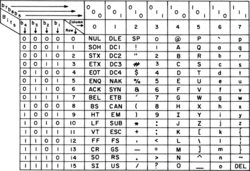
ASCII ( (listen) ASS-kee), abbreviated from American Standard Code for Information Interchange, is a character encoding standard for electronic communication. ASCII codes represent text in computers, telecommunications equipment, and other devices. Most modern character-encoding schemes are based on ASCII, although they support many additional characters. The Internet Assigned Numbers Authority (IANA) prefers the name US-ASCII for this character encoding.ASCII is one of the IEEE milestones.
ChatGPT
ascii
ASCII, which stands for American Standard Code for Information Interchange, is a character encoding standard used for electronic communication. It represents text in computers, communication equipment, and other devices that use text. ASCII codes represent text in digital devices such as computers by assigning a unique number for every character, including letters, numbers, punctuation marks, space, and control characters. It was developed from telegraphic codes and first published in 1963 by the American National Standards Institute (ANSI).
Webster Dictionary
Ascii
alt. of Ascians
Etymology: [Acronym: American Standard Code for Information Interchange.]
Wikidata
ASCII
The American Standard Code for Information Interchange is a character-encoding scheme originally based on the English alphabet. ASCII codes represent text in computers, communications equipment, and other devices that use text. Most modern character-encoding schemes are based on ASCII, though they support many additional characters. ASCII developed from telegraphic codes. Its first commercial use was as a seven-bit teleprinter code promoted by Bell data services. Work on the ASCII standard began on October 6, 1960, with the first meeting of the American Standards Association's X3.2 subcommittee. The first edition of the standard was published during 1963, a major revision during 1967, and the most recent update during 1986. Compared to earlier telegraph codes, the proposed Bell code and ASCII were both ordered for more convenient sorting of lists, and added features for devices other than teleprinters. ASCII includes definitions for 128 characters: 33 are non-printing control characters that affect how text and space are processed and 95 printable characters, including the space.
The New Hacker's Dictionary
ASCII
[originally an acronym (American Standard Code for Information Interchange) but now merely conventional] The predominant character set encoding of present-day computers. The standard version uses 7 bits for each character, whereas most earlier codes (including early drafts of ASCII prior to June 1961) used fewer. This change allowed the inclusion of lowercase letters — a major win — but it did not provide for accented letters or any other letterforms not used in English (such as the German sharp-S ß. or the ae-ligature æ which is a letter in, for example, Norwegian). It could be worse, though. It could be much worse. See EBCDIC to understand how. A history of ASCII and its ancestors is at http://www.wps.com/tex/definition/index.Computers are much pickier and less flexible about spelling than humans; thus, hackers need to be very precise when talking about characters, and have developed a considerable amount of verbal shorthand for them. Every character has one or more names — some formal, some concise, some silly. Common jargon names for ASCII characters are collected here. See also individual entries for bang, excl, open, ques, semi, shriek, splat, twiddle, and Yu-Shiang Whole Fish.This list derives from revision 2.3 of the Usenet ASCII pronunciation guide. Single characters are listed in ASCII order; character pairs are sorted in by first member. For each character, common names are given in rough order of popularity, followed by names that are reported but rarely seen; official ANSI/CCITT names are surrounded by brokets: <>. Square brackets mark the particularly silly names introduced by INTERCAL. The abbreviations “l/r” and “o/c” stand for left/right and “open/close” respectively. Ordinary parentheticals provide some usage information.!Common: bang ; pling; excl; not; shriek; ball-bat; <exclamation mark>. Rare: factorial; exclam; smash; cuss; boing; yell; wow; hey; wham; eureka; [spark-spot]; soldier, control."Common: double quote; quote. Rare: literal mark; double-glitch; snakebite; <quotation marks>; <dieresis>; dirk; [rabbit-ears]; double prime.#Common: number sign; pound; pound sign; hash; sharp; crunch ; hex; [mesh]. Rare: grid; crosshatch; octothorpe; flash; <square>, pig-pen; tictactoe; scratchmark; thud; thump; splat .$Common: dollar; <dollar sign>. Rare: currency symbol; buck; cash; bling; string (from BASIC); escape (when used as the echo of ASCII ESC); ding; cache; [big money].%Common: percent; <percent sign>; mod; grapes. Rare: [doub
Dictionary of Nautical Terms
ascii
The inhabitants of the torrid zone, who twice a year, being under a vertical sun, have no shadow.
Matched Categories
Anagrams for ASCII »
Isiac
Numerology
Chaldean Numerology
The numerical value of ASCII in Chaldean Numerology is: 9
Pythagorean Numerology
The numerical value of ASCII in Pythagorean Numerology is: 5
Popularity rank by frequency of use
References
Translations for ASCII
From our Multilingual Translation Dictionary
Get even more translations for ASCII »
Translation
Find a translation for the ASCII definition in other languages:
Select another language:
- - Select -
- 简体中文 (Chinese - Simplified)
- 繁體中文 (Chinese - Traditional)
- Español (Spanish)
- Esperanto (Esperanto)
- 日本語 (Japanese)
- Português (Portuguese)
- Deutsch (German)
- العربية (Arabic)
- Français (French)
- Русский (Russian)
- ಕನ್ನಡ (Kannada)
- 한국어 (Korean)
- עברית (Hebrew)
- Gaeilge (Irish)
- Українська (Ukrainian)
- اردو (Urdu)
- Magyar (Hungarian)
- मानक हिन्दी (Hindi)
- Indonesia (Indonesian)
- Italiano (Italian)
- தமிழ் (Tamil)
- Türkçe (Turkish)
- తెలుగు (Telugu)
- ภาษาไทย (Thai)
- Tiếng Việt (Vietnamese)
- Čeština (Czech)
- Polski (Polish)
- Bahasa Indonesia (Indonesian)
- Românește (Romanian)
- Nederlands (Dutch)
- Ελληνικά (Greek)
- Latinum (Latin)
- Svenska (Swedish)
- Dansk (Danish)
- Suomi (Finnish)
- فارسی (Persian)
- ייִדיש (Yiddish)
- հայերեն (Armenian)
- Norsk (Norwegian)
- English (English)
Word of the Day
Would you like us to send you a FREE new word definition delivered to your inbox daily?
Citation
Use the citation below to add this definition to your bibliography:
Style:MLAChicagoAPA
"ASCII." Definitions.net. STANDS4 LLC, 2024. Web. 26 Apr. 2024. <https://www.definitions.net/definition/ASCII>.


Discuss these ASCII definitions with the community:
Report Comment
We're doing our best to make sure our content is useful, accurate and safe.
If by any chance you spot an inappropriate comment while navigating through our website please use this form to let us know, and we'll take care of it shortly.
Attachment
You need to be logged in to favorite.
Log In