
What does APE mean?
Definitions for APE
eɪpape
This dictionary definitions page includes all the possible meanings, example usage and translations of the word APE.
Princeton's WordNet
apenoun
any of various primates with short tails or no tail at all
copycat, imitator, emulator, ape, apernoun
someone who copies the words or behavior of another
anthropoid, apeverb
person who resembles a nonhuman primate
apeverb
imitate uncritically and in every aspect
"Her little brother apes her behavior"
caricature, apeverb
represent in or produce a caricature of
"The drawing caricatured the President"
Wiktionary
apenoun
An animal of a class of primates generally larger than monkeys and distinguished from them by having no tail.
apenoun
An uncivilised person.
apeverb
To behave like an ape.
apeverb
To imitate; mimic.
apeadjective
Wild; crazy.
Samuel Johnson's Dictionary
APEnoun
Etymology: ape, Icelandish.
I will be more newfangled than an ape, more giddy in my desires than a monkey. William Shakespeare, As you like it.
Writers report, that the heart of an ape worn near the heart, comforteth the heart, and increaseth audacity. It is true, that the ape is a merry and bold beast. Francis Bacon, Natural History.
With glittering gold and sparkling gems they shine,
But apes and monkeys are the gods within. George Granville.Julio Romano, who, had he himself eternity, and could put breath into his work, would beguile nature of her custom: so perfectly he is her ape. William Shakespeare, Winter’s Tale.
To Apeverb
To imitate, as an ape imitates human actions.
Etymology: from ape.
Aping the foreigners in every dress,
Which, bought at greater cost, becomes him less. Dryden.Curse on the stripling! how he apes his sire!
Ambitiously sententious! Joseph Addison, Cato.
ChatGPT
ape
An ape is a type of large primate that lacks a tail and is often ascribed with high levels of intelligence and sociability. This category of mammals includes various species such as gorillas, chimpanzees, orangutans, and bonobos, along with humans. Apes are native to Africa and Asia, and they can walk on two legs or all fours. They mainly eat plants and small animals and usually live in social groups. They have a variety of sizes, ranging from the smaller gibbons to the much larger gorillas.
Webster Dictionary
Apenoun
a quadrumanous mammal, esp. of the family Simiadae, having teeth of the same number and form as in man, and possessing neither a tail nor cheek pouches. The name is applied esp. to species of the genus Hylobates, and is sometimes used as a general term for all Quadrumana. The higher forms, the gorilla, chimpanzee, and ourang, are often called anthropoid apes or man apes
Apenoun
one who imitates servilely (in allusion to the manners of the ape); a mimic
Apenoun
a dupe
Apeverb
to mimic, as an ape imitates human actions; to imitate or follow servilely or irrationally
Etymology: [AS. apa; akin to D. aap, OHG. affo, G. affe, Icel. api, Sw. apa, Dan. abe, W. epa.]
Wikidata
Ape
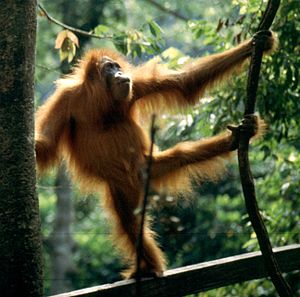
Apes are Old World anthropoid mammals, more specifically a clade of tailless catarrhine primates, belonging to the biological superfamily Hominoidea. The apes are native to Africa and South-east Asia. Apes are the largest primates and the orangutan, an ape, is the largest living arboreal animal. Hominoids are traditionally forest dwellers, although chimpanzees may range into savanna, and the extinct australopithecines were likely also savanna inhabitants, inferred from their morphology. Humans inhabit almost every terrestrial habitat. Hominoidea contains two families of living species: ⁕Hylobatidae consists of four genera and sixteen species of gibbon, including the lar gibbon and the siamang. They are commonly referred to as lesser apes. ⁕Hominidae consists of orangutans, gorillas, chimpanzees, bonobos and humans. Alternatively, the hominidae family are collectively described as the great apes. There are two extant species in the orangutan genus, two species in the gorilla genus, and a single extant species Homo sapiens in the human genus. Chimpanzees and bonobos are closely related to each other and they represent the two species in the genus Pan.
Chambers 20th Century Dictionary
Ape
āp, n. a monkey: a monkey without a tail or with a very short one: a simian proper, linking man and the lower animals, and hence termed Anthropoid—gorilla, chimpanzee, orang-outang, or gibbon: one who plays the ape, a silly imitator: (Shak.) an imitator in a good or neutral sense.—v.t. to imitate as an ape.—ns. Ape′dom; Ape′hood; Ap′ery, conduct of one who apes, any ape-like action: a colony of apes.—adj. Ap′ish, like an ape: imitative: foppish.—adv. Ap′ishly.—ns. Ap′ishness, Ap′ism (Carlyle).—God's ape, a born fool.—To lead apes in hell, believed to be the lot of old maids there; To make any one his ape, To put an ape in his hood (obs.), to make a fool of any one. [A.S. apa; Ger. affe.]
Dictionary of Nautical Terms
ape
The long-tailed shark. Also, an active American seal.
Suggested Resources
ape
Song lyrics by ape -- Explore a large variety of song lyrics performed by ape on the Lyrics.com website.
APE
What does APE stand for? -- Explore the various meanings for the APE acronym on the Abbreviations.com website.
Anagrams for APE »
EAP
EPA
PAE
pea
Numerology
Chaldean Numerology
The numerical value of APE in Chaldean Numerology is: 5
Pythagorean Numerology
The numerical value of APE in Pythagorean Numerology is: 4
Examples of APE in a Sentence
The Council considers that the cartoon uses exaggeration and absurdity to make its point, but accepts the publisher's claim that it does not depict Ms. Williams as an ape, rather showing her as 'spitting the dummy'.
Man ceased to be an ape, vanquished the ape, on the day the first book was written.
It is even harder for the average ape to believe that he has descended from man.
Language is political. That's why you and me, my Brother and Sister, that's why we supposed to choke our natural self into the weird, lying, barbarous, unreal, white speech and writing habits that the schools lay down like holy law. Because, in other words, the powerful don't play; they mean to keep that power, and those who are the powerless (you and me) better shape up --mimic/ape/suck --in the very image of the powerful, or the powerful will destroy you --you and our children.
It will be refreshing to have a classy, beautiful, dignified First Lady in the White House. I’m tired of seeing a Ape in heels.
Popularity rank by frequency of use
References
Translations for APE
From our Multilingual Translation Dictionary
- aapAfrikaans
- سعدان, حبن, قردArabic
- малпаBelarusian
- подражавам, маймунаBulgarian
- opiceCzech
- abeDanish
- Menschenaffe, nachäffen, AffeGerman
- πίθηκος, πιθηκίζωGreek
- homoideo, simiiEsperanto
- mono, imitar, remedarSpanish
- ahvEstonian
- بوزینه, کپی, تقلید کردن, کپی کردنPersian
- apina, matkia, ihmisapina, apinoidaFinnish
- apaFaroese
- hominoïdé, singe, singer, singe anthropoïdeFrench
- aapWestern Frisian
- קוף אדםHebrew
- कपि, वानरHindi
- emberszabású majom, majomHungarian
- մարդանման կապիկ, կապիկArmenian
- keraIndonesian
- api, apa eftirIcelandic
- scimmia, scimmiottare, scimmione, ominideItalian
- 類人猿, サル, 猿Japanese
- მაიმუნიGeorgian
- ស្វាKhmer
- 유인원, 원숭이, 類人猿Korean
- sīmius, sīmiaLatin
- AfLuxembourgish, Letzeburgesch
- beždžiõnėLithuanian
- мајмунMacedonian
- сармагчинMongolian
- mensaap, nabootsen, apin, nadoen, na-apen, aap, imiterenDutch
- apeNorwegian
- mágíNavajo, Navaho
- małpa, małpa człekokształtna, imitować, małpowaćPolish
- macaquear, macaco, imitarPortuguese
- maimuță, maimuțări, imitaRomanian
- обезьяна, подражать, обезьянничать, человекообразная обезьянаRussian
- majmun, мајмунSerbo-Croatian
- opicaSlovak
- opicaSlovene
- apa efter, härma, apa, människoapaSwedish
- маймунTajik
- จ๋อThai
- bakulawTagalog
- insansı maymunTurkish
- мавпувати, мавпаUkrainian
- بندرUrdu
- siêu họ Người, vượnVietnamese
- jilepül, hilep, hilepül, lep, lepil, jilep, lepül, lelepVolapük
- séndje, mårticotWalloon
Get even more translations for APE »
Translation
Find a translation for the APE definition in other languages:
Select another language:
- - Select -
- 简体中文 (Chinese - Simplified)
- 繁體中文 (Chinese - Traditional)
- Español (Spanish)
- Esperanto (Esperanto)
- 日本語 (Japanese)
- Português (Portuguese)
- Deutsch (German)
- العربية (Arabic)
- Français (French)
- Русский (Russian)
- ಕನ್ನಡ (Kannada)
- 한국어 (Korean)
- עברית (Hebrew)
- Gaeilge (Irish)
- Українська (Ukrainian)
- اردو (Urdu)
- Magyar (Hungarian)
- मानक हिन्दी (Hindi)
- Indonesia (Indonesian)
- Italiano (Italian)
- தமிழ் (Tamil)
- Türkçe (Turkish)
- తెలుగు (Telugu)
- ภาษาไทย (Thai)
- Tiếng Việt (Vietnamese)
- Čeština (Czech)
- Polski (Polish)
- Bahasa Indonesia (Indonesian)
- Românește (Romanian)
- Nederlands (Dutch)
- Ελληνικά (Greek)
- Latinum (Latin)
- Svenska (Swedish)
- Dansk (Danish)
- Suomi (Finnish)
- فارسی (Persian)
- ייִדיש (Yiddish)
- հայերեն (Armenian)
- Norsk (Norwegian)
- English (English)
Word of the Day
Would you like us to send you a FREE new word definition delivered to your inbox daily?
Citation
Use the citation below to add this definition to your bibliography:
Style:MLAChicagoAPA
"APE." Definitions.net. STANDS4 LLC, 2024. Web. 28 Apr. 2024. <https://www.definitions.net/definition/APE>.


Discuss these APE definitions with the community:
Report Comment
We're doing our best to make sure our content is useful, accurate and safe.
If by any chance you spot an inappropriate comment while navigating through our website please use this form to let us know, and we'll take care of it shortly.
Attachment
You need to be logged in to favorite.
Log In