
What does syllable mean?
Definitions for syllable
ˈsɪl ə bəlsyl·la·ble
This dictionary definitions page includes all the possible meanings, example usage and translations of the word syllable.
Princeton's WordNet
syllablenoun
a unit of spoken language larger than a phoneme
"the word `pocket' has two syllables"
Wiktionary
syllablenoun
A unit of human speech that is interpreted by the listener as a single sound, although syllables usually consist of one or more vowel sounds, either alone or combined with the sound of one or more consonants; a word consists of one or more syllables.
syllablenoun
The written representation of a given pronounced syllable.
syllableverb
To utter in syllables.
Aery tongues that syllable men's names uE00025979uE001 Milton.
Etymology: Middle English and Middle French sillabe, from syllaba, from συλλαβή, from συλλαμβάνω, from συν + λαμβάνω.
Samuel Johnson's Dictionary
SYLLABLEnoun
Etymology: συλλαϐὴ; syllabe, French.
I heard
Each syllable that breath made up between them. William Shakespeare.There is that property in all letters of aptness to be conjoined in syllables and words, through the voluble motions of the organs from one stop or figure to another, that they modify and discriminate the voice without appearing to discontinue it. William Holder, Elements of Speech.
Abraham, Job, and the rest that lived before any syllable of the law of God was written, did they not sin as much as we do in every action not commanded? Richard Hooker.
To-morrow, and to-morrow, and to-morrow,
Creeps in this petty pace from day to day,
To the last syllable of recorded time;
And all our yesterdays have lighted fools
The way to dusty death. William Shakespeare, Macbeth.He hath told so many melancholy stories, without one syllable of truth, that he hath blunted the edge of my fears. Jonathan Swift.
To Syllableverb
To utter; to pronounce; to articulate. Not in use.
Etymology: from the noun.
Airy tongues that syllable mens names
On sands and shores, and desart wildernesses. John Milton.
Wikipedia
Syllable
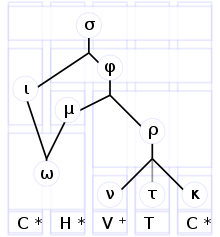
A syllable is a unit of organization for a sequence of speech sounds typically made up of a syllable nucleus (most often a vowel) with optional initial and final margins (typically, consonants). Syllables are often considered the phonological "building blocks" of words. They can influence the rhythm of a language, its prosody, its poetic metre and its stress patterns. Speech can usually be divided up into a whole number of syllables: for example, the word ignite is made of two syllables: ig and nite. Syllabic writing began several hundred years before the first letters. The earliest recorded syllables are on tablets written around 2800 BC in the Sumerian city of Ur. This shift from pictograms to syllables has been called "the most important advance in the history of writing".A word that consists of a single syllable (like English dog) is called a monosyllable (and is said to be monosyllabic). Similar terms include disyllable (and disyllabic; also bisyllable and bisyllabic) for a word of two syllables; trisyllable (and trisyllabic) for a word of three syllables; and polysyllable (and polysyllabic), which may refer either to a word of more than three syllables or to any word of more than one syllable.
ChatGPT
syllable
A syllable is a unit of pronunciation in linguistics that typically consists of a vowel or vowel sound, possibly accompanied by consonantal sounds, considered as the smallest phonetic unit of a word. It is a single, uninterrupted sound that forms a word or part of a word. Every word is made up of at least one syllable.
Webster Dictionary
Syllablenoun
an elementary sound, or a combination of elementary sounds, uttered together, or with a single effort or impulse of the voice, and constituting a word or a part of a word. In other terms, it is a vowel or a diphtong, either by itself or flanked by one or more consonants, the whole produced by a single impulse or utterance. One of the liquids, l, m, n, may fill the place of a vowel in a syllable. Adjoining syllables in a word or phrase need not to be marked off by a pause, but only by such an abatement and renewal, or reenforcement, of the stress as to give the feeling of separate impulses. See Guide to Pronunciation, /275
Syllablenoun
in writing and printing, a part of a word, separated from the rest, and capable of being pronounced by a single impulse of the voice. It may or may not correspond to a syllable in the spoken language
Syllablenoun
a small part of a sentence or discourse; anything concise or short; a particle
Syllableverb
to pronounce the syllables of; to utter; to articulate
Etymology: [OE. sillable, OF. sillabe, F. syllabe, L. syllaba, Gr. that which is held together, several letters taken together so as to form one sound, a syllable, fr. to take together; with + to take; cf. Skr. labh, rabh. Cf. Lemma, Dilemma.]
Wikidata
Syllable
A syllable is a unit of organization for a sequence of speech sounds. For example, the word water is composed of two syllables: wa and ter. A syllable is typically made up of a syllable nucleus with optional initial and final margins. Syllables are often considered the phonological "building blocks" of words. They can influence the rhythm of a language, its prosody, its poetic meter and its stress patterns. Syllabic writing began several hundred years before the first letters. The earliest recorded syllables are on tablets written around 2800 BC in the Sumerian city of Ur. This shift from pictograms to syllables has been called "the most important advance in the history of writing". A word that consists of a single syllable is called a monosyllable. Similar terms include disyllable for a word of two syllables; trisyllable for a word of three syllables; and polysyllable, which may refer either to a word of more than three syllables or to any word of more than one syllable.
Chambers 20th Century Dictionary
Syllable
sil′a-bl, n. several letters taken together so as to form one sound: a word or part of a word uttered by a single effort of the voice: a small part of a sentence.—v.t. to express by syllables, to utter.—n. Syll′abary, a list of characters representing syllables—also Syllabā′rium.—adjs. Syllab′ic, -al, consisting of a syllable or syllables.—adv. Syllab′ically.—vs.t. Syllab′icāte, Syllab′ify (pa.t. and pa.p. syllab′ified), to form into syllables—ns. Syllabicā′tion, Syllabificā′tion; Syll′abism, syllabic character, representation of syllables. [L. syllaba—Gr. syllabē—syn, with, lab-, lambanein, to take.]
Matched Categories
Anagrams for syllable »
sellably
Numerology
Chaldean Numerology
The numerical value of syllable in Chaldean Numerology is: 3
Pythagorean Numerology
The numerical value of syllable in Pythagorean Numerology is: 7
Examples of syllable in a Sentence
It all blends into each other, ’Rich Man, Poor Man’ was an epiphany for me. ‘Elf’ was a delight. ‘Up’ was an unbelievable stroke. I think it ranks up at the top for Pixar. and it certainly was a wonderful shot in my arm and butt as to my career, but ‘Elf’ and ‘Up,’ I am down to single syllable names these days.
A lot of people are waiting for (the Fed) - basically every syllable of their pronouncement and whatever their view is looking forward.
I have lived some thirty-odd years on this planet, and I have yet to hear the first syllable of valuable or even earnest advice from my seniors.
I try to write conversationally; I try to write like people speak and put the emphasis on the right syllable.
Cosmos is God, who whispered the syllable of life.
Popularity rank by frequency of use
References
Translations for syllable
From our Multilingual Translation Dictionary
- lettergrepe, lettergreepAfrikaans
- ижекBashkir
- síl·labaCatalan, Valencian
- slabikaCzech
- stavelseDanish
- SilbeGerman
- συλλαβή, συλλαβίζωGreek
- silaboEsperanto
- sílabaSpanish
- tavuFinnish
- syllabeFrench
- siollaIrish
- lideScottish Gaelic
- szótagHungarian
- վանկArmenian
- samstafa, atkvæðiIcelandic
- sillabaItalian
- 音節Japanese
- მარცვალიGeorgian
- 음절Korean
- SilbLuxembourgish, Letzeburgesch
- слогMacedonian
- suku kataMalay
- staving, stavelseNorwegian
- lettergreepDutch
- stavingNorwegian Nynorsk
- sylabaPolish
- sílabaPortuguese
- silabăRomanian
- слогRussian
- slogSerbo-Croatian
- slabikaSlovak
- zlogSlovene
- stavelseSwedish
- พยางค์Thai
- heceTurkish
- silabVolapük
- 音節Chinese
Get even more translations for syllable »
Translation
Find a translation for the syllable definition in other languages:
Select another language:
- - Select -
- 简体中文 (Chinese - Simplified)
- 繁體中文 (Chinese - Traditional)
- Español (Spanish)
- Esperanto (Esperanto)
- 日本語 (Japanese)
- Português (Portuguese)
- Deutsch (German)
- العربية (Arabic)
- Français (French)
- Русский (Russian)
- ಕನ್ನಡ (Kannada)
- 한국어 (Korean)
- עברית (Hebrew)
- Gaeilge (Irish)
- Українська (Ukrainian)
- اردو (Urdu)
- Magyar (Hungarian)
- मानक हिन्दी (Hindi)
- Indonesia (Indonesian)
- Italiano (Italian)
- தமிழ் (Tamil)
- Türkçe (Turkish)
- తెలుగు (Telugu)
- ภาษาไทย (Thai)
- Tiếng Việt (Vietnamese)
- Čeština (Czech)
- Polski (Polish)
- Bahasa Indonesia (Indonesian)
- Românește (Romanian)
- Nederlands (Dutch)
- Ελληνικά (Greek)
- Latinum (Latin)
- Svenska (Swedish)
- Dansk (Danish)
- Suomi (Finnish)
- فارسی (Persian)
- ייִדיש (Yiddish)
- հայերեն (Armenian)
- Norsk (Norwegian)
- English (English)
Word of the Day
Would you like us to send you a FREE new word definition delivered to your inbox daily?
Citation
Use the citation below to add this definition to your bibliography:
Style:MLAChicagoAPA
"syllable." Definitions.net. STANDS4 LLC, 2024. Web. 25 Apr. 2024. <https://www.definitions.net/definition/syllable>.


Discuss these syllable definitions with the community:
Report Comment
We're doing our best to make sure our content is useful, accurate and safe.
If by any chance you spot an inappropriate comment while navigating through our website please use this form to let us know, and we'll take care of it shortly.
Attachment
You need to be logged in to favorite.
Log In