What does silicon mean?
Definitions for silicon
ˈsɪl ɪ kən, -ˌkɒnsil·i·con
This dictionary definitions page includes all the possible meanings, example usage and translations of the word silicon.
Princeton's WordNet
silicon, Si, atomic number 14noun
a tetravalent nonmetallic element; next to oxygen it is the most abundant element in the earth's crust; occurs in clay and feldspar and granite and quartz and sand; used as a semiconductor in transistors
Wiktionary
siliconnoun
A nonmetallic element (symbol Si) with an atomic number of 14 and atomic weight of 28.0855.
Etymology: From the stem of silex ‘silica’.
Wikipedia
Silicon
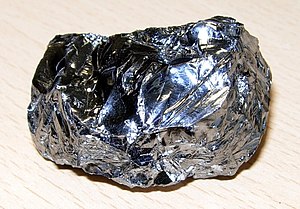
Silicon is a chemical element with the symbol Si and atomic number 14. It is a hard, brittle crystalline solid with a blue-grey metallic luster, and is a tetravalent metalloid and semiconductor. It is a member of group 14 in the periodic table: carbon is above it; and germanium, tin, lead, and flerovium are below it. It is relatively unreactive. Because of its high chemical affinity for oxygen, it was not until 1823 that Jöns Jakob Berzelius was first able to prepare it and characterize it in pure form. Its oxides form a family of anions known as silicates. Its melting and boiling points of 1414 °C and 3265 °C, respectively, are the second highest among all the metalloids and nonmetals, being surpassed only by boron. Silicon is the eighth most common element in the universe by mass, but very rarely occurs as the pure element in the Earth's crust. It is widely distributed in space in cosmic dusts, planetoids, and planets as various forms of silicon dioxide (silica) or silicates. More than 90% of the Earth's crust is composed of silicate minerals, making silicon the second most abundant element in the Earth's crust (about 28% by mass), after oxygen. Most silicon is used commercially without being separated, often with very little processing of the natural minerals. Such use includes industrial construction with clays, silica sand, and stone. Silicates are used in Portland cement for mortar and stucco, and mixed with silica sand and gravel to make concrete for walkways, foundations, and roads. They are also used in whiteware ceramics such as porcelain, and in traditional silicate-based soda-lime glass and many other specialty glasses. Silicon compounds such as silicon carbide are used as abrasives and components of high-strength ceramics. Silicon is the basis of the widely used synthetic polymers called silicones. The late 20th century to early 21st century has been described as the Silicon Age (also known as the Digital Age or Information Age) because of the large impact that elemental silicon has on the modern world economy. The small portion of very highly purified elemental silicon used in semiconductor electronics (<10%) is essential to the transistors and integrated circuit chips used in most modern technology such as smartphones and other computers. In 2019, 32.4% of the semiconductor market segment was for networks and communications devices, and the semiconductors industry is projected to reach $726.73 billion by 2027. Silicon is an essential element in biology. Only traces are required by most animals, but some sea sponges and microorganisms, such as diatoms and radiolaria, secrete skeletal structures made of silica. Silica is deposited in many plant tissues.
ChatGPT
silicon
Silicon is a chemical element with the symbol Si and atomic number 14. It is a hard, brittle crystalline solid with a blue-grey metallic lustre, and is a tetravalent metalloid and semiconductor. It is a member of group 14 in the periodic table: carbon is above it, and germanium, tin and lead are below it. It is widely distributed in dusts, sands, and planetoids as various forms of silicon dioxide or silicates. Silicon is the second most abundant element in the Earth's crust, after oxygen. It is commonly used in semiconductors, fiber optic cables, and ceramics.
Webster Dictionary
Siliconnoun
a nonmetalic element analogous to carbon. It always occurs combined in nature, and is artificially obtained in the free state, usually as a dark brown amorphous powder, or as a dark crystalline substance with a meetallic luster. Its oxide is silica, or common quartz, and in this form, or as silicates, it is, next to oxygen, the most abundant element of the earth's crust. Silicon is characteristically the element of the mineral kingdom, as carbon is of the organic world. Symbol Si. Atomic weight 28. Called also silicium
Etymology: [See Silica.]
Wikidata
Silicon
Silicon, a tetravalent metalloid, is a chemical element with the symbol Si and atomic number 14. It is less reactive than its chemical analog carbon, the nonmetal directly above it in the periodic table, but more reactive than germanium, the metalloid directly below it in the table. Controversy about silicon's character dates to its discovery; it was first prepared and characterized in pure form in 1823. In 1808, it was given the name silicium, with an -ium word-ending to suggest a metal, a name which the element retains in several non-English languages. However, its final English name, first suggested in 1817, reflects the more physically similar elements carbon and boron. Silicon is the eighth most common element in the universe by mass, but very rarely occurs as the pure free element in nature. It is most widely distributed in dusts, sands, planetoids, and planets as various forms of silicon dioxide or silicates. Over 90% of the Earth's crust is composed of silicate minerals, making silicon the second most abundant element in the Earth's crust after oxygen. Most silicon is used commercially without being separated, and indeed often with little processing of compounds from nature. These include direct industrial building-use of clays, silica sand and stone. Silica is used in ceramic brick. Silicate goes into Portland cement for mortar and stucco, and when combined with silica sand and gravel, to make concrete. Silicates are also in whiteware ceramics such as porcelain, and in traditional quartz-based soda-lime glass. More modern silicon compounds such as silicon carbide form abrasives and high-strength ceramics. Silicon is the basis of the ubiquitous synthetic silicon-based polymers called silicones.
The New Hacker's Dictionary
silicon
Hardware, esp. ICs or microprocessor-based computer systems (compare iron). Contrasted with software. See also sandbender.
U.S. National Library of Medicine
Silicon
A trace element that constitutes about 27.6% of the earth's crust in the form of SILICON DIOXIDE. It does not occur free in nature. Silicon has the atomic symbol Si, atomic number 14, and atomic weight 28.09.
Suggested Resources
silicon
Song lyrics by silicon -- Explore a large variety of song lyrics performed by silicon on the Lyrics.com website.
Matched Categories
Numerology
Chaldean Numerology
The numerical value of silicon in Chaldean Numerology is: 5
Pythagorean Numerology
The numerical value of silicon in Pythagorean Numerology is: 9
Examples of silicon in a Sentence
I think that Silicon Valley has to take a look at their products, if you create a product that allows evil monsters to communicate in this way, … that is a big problem.
What we're trying to do is bring together the best of Hollywood and the best of Silicon Valley to make viewing short-form content on your mobile extraordinary, we've got Hollywood quality content with some really very innovative technology that makes viewing video on your mobile something quite different than what it is today.
I’m a diversity and inclusion advocate, no matter where I am, whether it’s in the gun community, whether it’s in my day job in Silicon Valley.
( Facebook CEO Mark) Zuckerberg gave a billion to The Silicon Valley Community Foundation, and it's sitting there, it's actually sitting on Wall Street. It's not going out. ( Zuckerberg) hasn't decided what to do with it.
Silicon Valley giants might get more competition and more innovation in Silicon Valley in a world where Silicon Valley giants had more antitrust enforcement.
Popularity rank by frequency of use
References
Translations for silicon
From our Multilingual Translation Dictionary
- silikonAfrikaans
- سليكونArabic
- крэмнійBelarusian
- силицийBulgarian
- silikiom, silisiomBreton
- siliciCatalan, Valencian
- siliciuCorsican
- křemíkCzech
- siliconWelsh
- siliciumDanish
- Silicium, SiliziumGerman
- πυρίτιοGreek
- silicioEsperanto
- silicioSpanish
- räniEstonian
- silizioaBasque
- سیلیسیمPersian
- piiFinnish
- siliciumFaroese
- siliciumFrench
- silisiumWestern Frisian
- sileacanIrish
- sileaconScottish Gaelic
- silicioGalician
- સિલિકોનGujarati
- shillagonManx
- צורןHebrew
- सैकताHindi
- silisyòmHaitian Creole
- szilíciumHungarian
- սիլիցիումArmenian
- siliciumInterlingua
- silikonIndonesian
- silikoIdo
- kísillIcelandic
- silicioItalian
- シリコン, ケイ素Japanese
- სილიციუმიGeorgian
- кремнийKazakh
- ಸಿಲಿಕಾನ್Kannada
- 실리콘, 규소Korean
- sîlîsyûmKurdish
- sylyconCornish
- siliciumLatin
- SiliziumLuxembourgish, Letzeburgesch
- silicisLithuanian
- silīcijsLatvian
- takawaiMāori
- силициумMacedonian
- സിലിക്കണ്Malayalam
- цахиурMongolian
- सिलिकॉनMarathi
- silikonMalay
- silikonMaltese
- silisiumNorwegian
- siliciumDutch
- silisiumNorwegian Nynorsk
- siliciOccitan
- ਸਿਲੀਕੋਨPanjabi, Punjabi
- krzemPolish
- silícioPortuguese
- ullayayaqQuechua
- siliciuRomanian
- кремний, силицийRussian
- silicij, silicijum, силициј, силицијумSerbo-Croatian
- kremíkSlovak
- silicijSlovene
- siliciumAlbanian
- kiselSwedish
- சிலிக்கான்Tamil
- సిలికాన్Telugu
- силитсийTajik
- ซิลิคอนThai
- silisyumTurkish
- кремнійUkrainian
- кремнийUzbek
- silicVietnamese
Get even more translations for silicon »
Translation
Find a translation for the silicon definition in other languages:
Select another language:
- - Select -
- 简体中文 (Chinese - Simplified)
- 繁體中文 (Chinese - Traditional)
- Español (Spanish)
- Esperanto (Esperanto)
- 日本語 (Japanese)
- Português (Portuguese)
- Deutsch (German)
- العربية (Arabic)
- Français (French)
- Русский (Russian)
- ಕನ್ನಡ (Kannada)
- 한국어 (Korean)
- עברית (Hebrew)
- Gaeilge (Irish)
- Українська (Ukrainian)
- اردو (Urdu)
- Magyar (Hungarian)
- मानक हिन्दी (Hindi)
- Indonesia (Indonesian)
- Italiano (Italian)
- தமிழ் (Tamil)
- Türkçe (Turkish)
- తెలుగు (Telugu)
- ภาษาไทย (Thai)
- Tiếng Việt (Vietnamese)
- Čeština (Czech)
- Polski (Polish)
- Bahasa Indonesia (Indonesian)
- Românește (Romanian)
- Nederlands (Dutch)
- Ελληνικά (Greek)
- Latinum (Latin)
- Svenska (Swedish)
- Dansk (Danish)
- Suomi (Finnish)
- فارسی (Persian)
- ייִדיש (Yiddish)
- հայերեն (Armenian)
- Norsk (Norwegian)
- English (English)
Word of the Day
Would you like us to send you a FREE new word definition delivered to your inbox daily?
Citation
Use the citation below to add this definition to your bibliography:
Style:MLAChicagoAPA
"silicon." Definitions.net. STANDS4 LLC, 2024. Web. 16 Apr. 2024. <https://www.definitions.net/definition/silicon>.


Discuss these silicon definitions with the community:
Report Comment
We're doing our best to make sure our content is useful, accurate and safe.
If by any chance you spot an inappropriate comment while navigating through our website please use this form to let us know, and we'll take care of it shortly.
Attachment
You need to be logged in to favorite.
Log In