
What does dominican republic mean?
Definitions for dominican republic
do·mini·can re·pub·lic
This dictionary definitions page includes all the possible meanings, example usage and translations of the word dominican republic.
Princeton's WordNet
Dominican Republicnoun
a republic in the West Indies; located on the eastern two-thirds of the island of Hispaniola
Wiktionary
Dominican Republicnoun
A country in the Caribbean.
Wikipedia
Dominican Republic
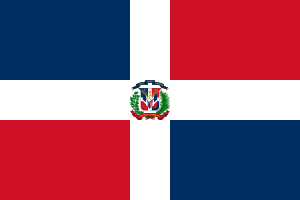
The Dominican Republic ( də-MIN-ik-ən; Spanish: República Dominicana, pronounced [reˈpuβlika ðominiˈkana] (listen)) is a country located on the island of Hispaniola in the Greater Antilles archipelago of the Caribbean region. It occupies the eastern five-eighths of the island, which it shares with Haiti, making Hispaniola one of only two Caribbean islands, along with Saint Martin, that is shared by two sovereign states. The Dominican Republic is the second-largest nation in the Antilles by area (after Cuba) at 48,671 square kilometers (18,792 sq mi), and third-largest by population, with approximately 10.7 million people (2022 est.), down from 10.8 million in 2020, of whom approximately 3.3 million live in the metropolitan area of Santo Domingo, the capital city. The official language of the country is Spanish. The native Taíno people had inhabited Hispaniola before the arrival of Europeans, dividing it into five chiefdoms. They had constructed an advanced farming and hunting society, and were in the process of becoming an organized civilization. The Taínos also inhabited Cuba, Jamaica, Puerto Rico, and the Bahamas. The Genoese mariner Christopher Columbus explored and claimed the island for Castile, landing there on his first voyage in 1492. The colony of Santo Domingo became the site of the first permanent European settlement in the Americas and the first seat of Spanish colonial rule in the New World. It would also become the site to introduce importations of enslaved Africans to the Americas. In 1697, Spain recognized French dominion over the western third of the island, which became the independent state of Haiti in 1804.After more than three hundred years of Spanish rule, the Dominican people declared independence in November 1821. The leader of the independence movement, José Núñez de Cáceres, intended the Dominican nation to unite with the country of Gran Colombia, but the newly independent Dominicans were forcefully annexed by Haiti in February 1822. Independence came 22 years later in 1844, after victory in the Dominican War of Independence. Over the next 72 years, the Dominican Republic experienced mostly civil wars (financed with loans from European merchants), several failed invasions by its neighbour, Haiti, and brief return to Spanish colonial status, before permanently ousting the Spanish during the Dominican War of Restoration of 1863–1865. During this period, three presidents were assassinated (José Antonio Salcedo in 1864, Ulises Heureaux in 1899, and Ramón Cáceres in 1911). The U.S. occupied the Dominican Republic (1916–1924) due to threats of defaulting on foreign debts; a subsequent calm and prosperous six-year period under Horacio Vásquez followed. From 1930 the dictatorship of Rafael Leónidas Trujillo ruled until his assassination in 1961. Juan Bosch was elected president in 1962 but was deposed in a military coup in 1963. A civil war in 1965, the country's last, was ended by U.S. military intervention and was followed by the authoritarian rule of Joaquín Balaguer (1966–1978 and 1986–1996). Since 1978, the Dominican Republic has moved toward representative democracy, and has been led by Leonel Fernández for most of the time after 1996. Danilo Medina succeeded Fernández in 2012, winning 51% of the electoral vote over his opponent ex-president Hipólito Mejía. He was later succeeded by Luis Abinader in the 2020 presidential election after anti-government protests erupted that year.The Dominican Republic has the largest economy (according to the U.S. State Department and the World Bank) in the Caribbean and Central American region and is the seventh-largest economy in Latin America. Over the last 25 years, the Dominican Republic has had the fastest-growing economy in the Western Hemisphere – with an average real GDP growth rate of 5.3% between 1992 and 2018. GDP growth in 2014 and 2015 reached 7.3 and 7.0%, respectively, the highest in the Western Hemisphere. In the first half of 2016, the Dominican economy grew 7.4% continuing its trend of rapid economic growth. Recent growth has been driven by construction, manufacturing, tourism, and mining. The country is the site of the third largest gold mine in the world, the Pueblo Viejo mine. Private consumption has been strong, as a result of low inflation (under 1% on average in 2015), job creation, and a high level of remittances. Income inequality, for generations an unsolved issue, has faded thanks to its rapid economic growth and now the Dominican Republic exhibits a Gini coefficient of 39, similar to that of Israel and Uruguay, and better than countries like the United States, Costa Rica or Chile. Illegal Immigration from Haiti has resulted in government action. Immigration from Haiti has increased tensions between Dominicans and Haitians. The Dominican Republic is also home to 114,050 illegal immigrants from Venezuela. According to the UN, the country struggles with systemic racism and discrimination based on race, mostly targeted toward
ChatGPT
dominican republic
The Dominican Republic is a country located on the eastern part of the Caribbean island of Hispaniola, sharing a border with Haiti. It is the second largest and most diverse Caribbean country, known for its warm and hospitable people, scenic beaches, all-inclusive resorts, and golfing. Santo Domingo, its capital, is the oldest permanent city settled by Europeans in the Americas and hosts the first university, cathedral, castle, and monastery of the New World. The Dominican Republic is a democratic republic with a multiparty political system and a president as head of state and government. The official language is Spanish and the currency used is the Dominican Peso.
Wikidata
Dominican Republic
The Dominican Republic; Spanish: República Dominicana, is a nation on the island of Hispaniola, part of the Greater Antilles archipelago in the Caribbean region. The western third of the island is occupied by the nation of Haiti, making Hispaniola one of two Caribbean islands, along with Saint Martin, that are shared by two countries. Both by area and population, the Dominican Republic is the second largest Caribbean nation (after Cuba), with 48,445 square kilometres (18,705 sq mi) and an estimated 10 million people, one million of which in the capital city, Santo Domingo. Taínos inhabited what is now the Dominican Republic since the 7th century. Christopher Columbus landed on it in 1492, and it became the site of the first permanent European settlement in the Americas, namely Santo Domingo, the country's capital and Spain's first capital in the New World. After three centuries of Spanish rule, with French and Haitian interludes, the country became independent in 1821. The ruler, José Núñez de Cáceres, intended that the Dominican Republic be part of the nation of Gran Colombia, but he was quickly removed by the Haitian government and "Dominican" slave revolts. Victorious in the Dominican War of Independence in 1844, Dominicans experienced mostly internal strife, and also a brief return to Spanish rule, over the next 72 years. The United States occupation of 1916–1924, and a subsequent calm and prosperous six-year period under Horacio Vásquez Lajara, were followed by the dictatorship of Rafael Leonidas Trujillo Molina until 1961. The civil war of 1965, the country's last, was ended by a U.S.-led intervention, and was followed by the authoritarian rule of Joaquín Balaguer, 1966–1978. Since then, the Dominican Republic has moved toward representative democracy, and has been led by Leonel Fernández for most of the time after 1996. Danilo Medina, Dominican Republic's current president, replaced former president Leonel Fernández holding 51% of the Electoral Vote over his opponent ex-president Hipolito Mejia in 2012.
The Nuttall Encyclopedia
Dominican Republic
or St. Domingo (610), a republic forming the E. part of the island of Haiti, and consisting of two-thirds of it; it belonged alternately to France and Spain till 1865, when, on revolt, the Spaniards were expelled, and a republic established; the capital is St. Domingo (15), and the chief port Puerto Plata.
U.S. National Library of Medicine
Dominican Republic
A republic in the Greater Antilles in the West Indies. Its capital is Santo Domingo. With Haiti, it forms the island of Hispaniola - the Dominican Republic occupying the eastern two thirds, and Haiti, the western third. It was created in 1844 after a revolt against the rule of President Boyer over the entire island of Hispaniola, itself visited by Columbus in 1492 and settled the next year. Except for a brief period of annexation to Spain (1861-65), it has been independent, though closely associated with the United States. Its name comes from the Spanish Santo Domingo, Holy Sunday, with reference to its discovery on a Sunday. (From Webster's New Geographical Dictionary, 1988, p338, 506 & Room, Brewer's Dictionary of Names, 1992, p151)
Matched Categories
Numerology
Chaldean Numerology
The numerical value of dominican republic in Chaldean Numerology is: 7
Pythagorean Numerology
The numerical value of dominican republic in Pythagorean Numerology is: 6
Examples of dominican republic in a Sentence
I truly believe if Will Cox was anywhere else in the world besides Dominican Republic Will Cox'd be alive right now.
If the banks and corporations feel that they can better exploit the people of Mississippi, New Hampshire, Hong Kong or Puerto Rico in order to make their blood profits -- let them go there, in the Dominican Republic, American companies pay native workers $ 2 a day for a full day's work. Vermont is not going to compete with that kind of slavery.
There's a subtext to this story that I don't want to be missed, the three officers that were involved, two of them were born outside this country, one in India and one in the Dominican Republic, the third is a first generation.
It definitely does n’t feel in there [ the clubhouse ] like we just beat the Dominican Republic to advance.
My ups and downs have been -- it's just part of the game, i've pitched some good games, as well. ... And all I'm focused on is trying to go out and help this team win. Daniel Volquez mourns father When Daniel Volquez slipped into the clubhouse after being taken out of Game 1 Daniel Volquez was greeted by Daniel Volquez wife, kids, brother and Royals General Manager Dayton Moore. They took Daniel Volquez into the manager's office and closed the door. Daniel Volquez father, the man who prodded him to take up baseball, was dead. Daniel Volquez, 63, died in the Dominican Republic from complications of a heart condition, MLB.com reported. The pitcher and his family flew to the Dominican for the funeral, but Daniel Volquez told The Royals Manager Ned Yost that Daniel Volquez would see the team in New York. Royals Manager Ned Yost said Royals Manager Ned Yost fully expects to see Volquez on the mound in Game 5, which would be Sunday, if necessary. Sleep ? O-ver-ra-ted !
References
Translations for dominican republic
From our Multilingual Translation Dictionary
Get even more translations for dominican republic »
Translation
Find a translation for the dominican republic definition in other languages:
Select another language:
- - Select -
- 简体中文 (Chinese - Simplified)
- 繁體中文 (Chinese - Traditional)
- Español (Spanish)
- Esperanto (Esperanto)
- 日本語 (Japanese)
- Português (Portuguese)
- Deutsch (German)
- العربية (Arabic)
- Français (French)
- Русский (Russian)
- ಕನ್ನಡ (Kannada)
- 한국어 (Korean)
- עברית (Hebrew)
- Gaeilge (Irish)
- Українська (Ukrainian)
- اردو (Urdu)
- Magyar (Hungarian)
- मानक हिन्दी (Hindi)
- Indonesia (Indonesian)
- Italiano (Italian)
- தமிழ் (Tamil)
- Türkçe (Turkish)
- తెలుగు (Telugu)
- ภาษาไทย (Thai)
- Tiếng Việt (Vietnamese)
- Čeština (Czech)
- Polski (Polish)
- Bahasa Indonesia (Indonesian)
- Românește (Romanian)
- Nederlands (Dutch)
- Ελληνικά (Greek)
- Latinum (Latin)
- Svenska (Swedish)
- Dansk (Danish)
- Suomi (Finnish)
- فارسی (Persian)
- ייִדיש (Yiddish)
- հայերեն (Armenian)
- Norsk (Norwegian)
- English (English)
Word of the Day
Would you like us to send you a FREE new word definition delivered to your inbox daily?
Citation
Use the citation below to add this definition to your bibliography:
Style:MLAChicagoAPA
"dominican republic." Definitions.net. STANDS4 LLC, 2024. Web. 27 Apr. 2024. <https://www.definitions.net/definition/dominican+republic>.


Discuss these dominican republic definitions with the community:
Report Comment
We're doing our best to make sure our content is useful, accurate and safe.
If by any chance you spot an inappropriate comment while navigating through our website please use this form to let us know, and we'll take care of it shortly.
Attachment
You need to be logged in to favorite.
Log In