
What does VIRUS mean?
Definitions for VIRUS
ˈvaɪ rəsvirus
This dictionary definitions page includes all the possible meanings, example usage and translations of the word VIRUS.
Princeton's WordNet
virusnoun
(virology) ultramicroscopic infectious agent that replicates itself only within cells of living hosts; many are pathogenic; a piece of nucleic acid (DNA or RNA) wrapped in a thin coat of protein
virusnoun
a harmful or corrupting agency
"bigotry is a virus that must not be allowed to spread"; "the virus of jealousy is latent in everyone"
virus, computer virusnoun
a software program capable of reproducing itself and usually capable of causing great harm to files or other programs on the same computer
"a true virus cannot spread to another computer without human assistance"
GCIDE
Virusnoun
(Computers) a program or segment of program code that may make copies of itself (replicate), attach itself to other programs, and perform unwanted actions within a computer; also called computer virus or virus program. Such programs are almost always introduced into a computer without the knowledge or assent of its owner, and are often malicious, causing destructive actions such as erasing data on disk, but sometime only annoying, causing peculiar objects to appear on the display. The form of sociopathic mental disease that causes a programmer to write such a program has not yet been given a name. Compare trojan horse.
Virusnoun
any of numerous submicroscopic complex organic objects which have genetic material and may be considered as living organisms but have no proper cell membrane, and thus cannot by themselves perform metabolic processes, requiring entry into a host cell in order to multiply. The simplest viruses have no lipid envelope and may be considered as complex aggregates of molecules, sometimes only a nucleic acid (DNA or RNA) and a coat protein. They are sometimes viewed as being on the borderline between living and nonliving objects. They are smaller than living cells in size, usually between 20 and 300 nm; thus they pass through standard filters, and were previously referred to as filterable virus. The manifestations of disease caused by multiplication of viruses in cells may be due to destruction of the cells caused by subversion of the cellular metabolic processes by the virus, or by synthesis of a virus-specific toxin. Viruses may infect animals, plants, or microorganisms; those infecting bacteria are also called bacteriophages. Certain bacteriophages may be non-destructive and benign in the host; -- see bacteriophage.
Wiktionary
virusnoun
Venom, as produced by a poisonous animal etc.
virusnoun
A submicroscopic infectious organism, now understood to be a non-cellular structure consisting of a core of DNA or RNA surrounded by a protein coat. It requires a living cell to replicate, and often causes disease in the host organism.
virusnoun
A computer virus.
Etymology: From virus. First use in the computer context by David Gerrold in his 1972 book When HARLIE Was One.
Wikipedia
Virus
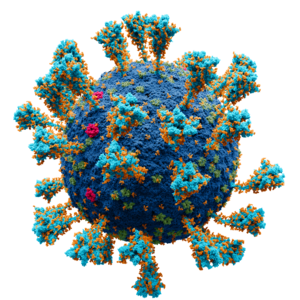
A virus is a submicroscopic infectious agent that replicates only inside the living cells of an organism. Viruses infect all life forms, from animals and plants to microorganisms, including bacteria and archaea. Since Dmitri Ivanovsky's 1892 article describing a non-bacterial pathogen infecting tobacco plants and the discovery of the tobacco mosaic virus by Martinus Beijerinck in 1898, more than 9,000 virus species have been described in detail of the millions of types of viruses in the environment. Viruses are found in almost every ecosystem on Earth and are the most numerous type of biological entity. The study of viruses is known as virology, a subspeciality of microbiology. When infected, a host cell is often forced to rapidly produce thousands of copies of the original virus. When not inside an infected cell or in the process of infecting a cell, viruses exist in the form of independent particles, or virions, consisting of (i) the genetic material, i.e., long molecules of DNA or RNA that encode the structure of the proteins by which the virus acts; (ii) a protein coat, the capsid, which surrounds and protects the genetic material; and in some cases (iii) an outside envelope of lipids. The shapes of these virus particles range from simple helical and icosahedral forms to more complex structures. Most virus species have virions too small to be seen with an optical microscope and are one-hundredth the size of most bacteria. The origins of viruses in the evolutionary history of life are unclear: some may have evolved from plasmids—pieces of DNA that can move between cells—while others may have evolved from bacteria. In evolution, viruses are an important means of horizontal gene transfer, which increases genetic diversity in a way analogous to sexual reproduction. Viruses are considered by some biologists to be a life form, because they carry genetic material, reproduce, and evolve through natural selection, although they lack the key characteristics, such as cell structure, that are generally considered necessary criteria for defining life. Because they possess some but not all such qualities, viruses have been described as "organisms at the edge of life", and as replicators.Viruses spread in many ways. One transmission pathway is through disease-bearing organisms known as vectors: for example, viruses are often transmitted from plant to plant by insects that feed on plant sap, such as aphids; and viruses in animals can be carried by blood-sucking insects. Many viruses, including influenza viruses, SARS-CoV-2, chickenpox, smallpox, and measles, spread in the air by coughing and sneezing. Norovirus and rotavirus, common causes of viral gastroenteritis, are transmitted by the faecal–oral route, passed by hand-to-mouth contact or in food or water. The infectious dose of norovirus required to produce infection in humans is fewer than 100 particles. HIV is one of several viruses transmitted through sexual contact and by exposure to infected blood. The variety of host cells that a virus can infect is called its "host range". This can be narrow, meaning a virus is capable of infecting few species, or broad, meaning it is capable of infecting many.Viral infections in animals provoke an immune response that usually eliminates the infecting virus. Immune responses can also be produced by vaccines, which confer an artificially acquired immunity to the specific viral infection. Some viruses, including those that cause HIV/AIDS, HPV infection, and viral hepatitis, evade these immune responses and result in chronic infections. Several classes of antiviral drugs have been developed.
ChatGPT
virus
A virus is a microscopic infectious agent that replicates only inside the living cells of an organism. It can infect all types of life forms, from animals and plants to microorganisms, including bacteria and archaea. A virus consists of a core of genetic material (either DNA or RNA) surrounded by a protective coat of protein called a capsid. Some viruses may also have an outer envelope made from the host cell's membrane. Viruses can cause various diseases in humans, ranging from common colds and flu to more severe illnesses like Ebola and COVID-19.
Webster Dictionary
Virusverb
contagious or poisonous matter, as of specific ulcers, the bite of snakes, etc.; -- applied to organic poisons
Virusverb
the special contagion, inappreciable to the senses and acting in exceedingly minute quantities, by which a disease is introduced into the organism and maintained there
Virusverb
fig.: Any morbid corrupting quality in intellectual or moral conditions; something that poisons the mind or the soul; as, the virus of obscene books
Etymology: [L., a slimy liquid, a poisonous liquid, poison, stench; akin to Gr. poison, Skr. visha. Cf. Wizen, v. i.]
Wikidata
Virus
A virus is a small infectious agent that can replicate only inside the living cells of an organism. Viruses can infect all types of organisms, from animals and plants to bacteria and archaea. Since Dmitri Ivanovsky's 1892 article describing a non-bacterial pathogen infecting tobacco plants, and the discovery of the tobacco mosaic virus by Martinus Beijerinck in 1898, about 5,000 viruses have been described in detail, although there are millions of different types. Viruses are found in almost every ecosystem on Earth and are the most abundant type of biological entity. The study of viruses is known as virology, a sub-speciality of microbiology. Virus particles consist of two or three parts: i the genetic material made from either DNA or RNA, long molecules that carry genetic information; ii a protein coat that protects these genes; and in some cases iii an envelope of lipids that surrounds the protein coat when they are outside a cell. The shapes of viruses range from simple helical and icosahedral forms to more complex structures. The average virus is about one one-hundredth the size of the average bacterium. Most viruses are too small to be seen directly with an optical microscope.
Chambers 20th Century Dictionary
Virus
vī′rus, n. contagious or poisonous matter (as of ulcers, &c.): the poison which causes infection: any foul, hurtful matter.—adjs. Vī′rose, Vī′rous; Virūlif′erous, bearing a specific virus. [L.; cog. with Gr. ios, Sans. visha, poison.]
The New Hacker's Dictionary
virus
[from the obvious analogy with biological viruses, via SF] A cracker program that searches out other programs and ‘infects’ them by embedding a copy of itself in them, so that they become Trojan horses. When these programs are executed, the embedded virus is executed too, thus propagating the ‘infection’. This normally happens invisibly to the user. Unlike a worm, a virus cannot infect other computers without assistance. It is propagated by vectors such as humans trading programs with their friends (see SEX). The virus may do nothing but propagate itself and then allow the program to run normally. Usually, however, after propagating silently for a while, it starts doing things like writing cute messages on the terminal or playing strange tricks with the display (some viruses include nice display hacks). Many nasty viruses, written by particularly perversely minded crackers, do irreversible damage, like nuking all the user's files.In the 1990s, viruses became a serious problem, especially among Windows users; the lack of security on these machines enables viruses to spread easily, even infecting the operating system (Unix machines, by contrast, are immune to such attacks). The production of special anti-virus software has become an industry, and a number of exaggerated media reports have caused outbreaks of near hysteria among users; many lusers tend to blame everything that doesn't work as they had expected on virus attacks. Accordingly, this sense of virus has passed not only into techspeak but into also popular usage (where it is often incorrectly used to denote a worm or even a Trojan horse). See phage; compare back door; see also Unix conspiracy.
Suggested Resources
virus
Song lyrics by virus -- Explore a large variety of song lyrics performed by virus on the Lyrics.com website.
Surnames Frequency by Census Records
VIRUS
According to the U.S. Census Bureau, Virus is ranked #153769 in terms of the most common surnames in America.
The Virus surname appeared 106 times in the 2010 census and if you were to sample 100,000 people in the United States, approximately 0 would have the surname Virus.
95.2% or 101 total occurrences were White.
Matched Categories
British National Corpus
Nouns Frequency
Rank popularity for the word 'VIRUS' in Nouns Frequency: #1846
Numerology
Chaldean Numerology
The numerical value of VIRUS in Chaldean Numerology is: 9
Pythagorean Numerology
The numerical value of VIRUS in Pythagorean Numerology is: 8
Examples of VIRUS in a Sentence
It's very unlikely that they would be able to spread the disease to fellow passengers, the Ebola virus spreads through direct contact with the blood, secretions, or other body fluids of ill people, and indirect contact -- for example with needles and other things that may be contaminated with these fluids.
There were so many times, day and night, our team had to react quickly to help her oxygenation and support her other organs to make sure they were healthy enough to support a transplant if and when the opportunity came, one of the most exciting times was when the first coronavirus test came back negative and we had the first sign she may have cleared the virus to become eligible for a life-saving transplant.
The momentum is positive as a lot of money is coming into the emerging markets. The vaccine development is also earlier than anticipated, it is expected that we will be out of this virus issue this year. The economy is likely to open further. We will have a strong earnings growth and also have a lot of liquidity in the market. These (expectations) are helping the market.
But at that time, we did not know that the virus had entered Iran.
Many of these counties are also the same locations where the Delta variant represents the large majority of circulating virus, low vaccination rates in these counties, coupled with high case rates -- and lax mitigation policies that do not protect those who are unvaccinated from disease -- will certainly, and sadly, lead to more unnecessary suffering, hospitalizations and potentially deaths.
Popularity rank by frequency of use
References
Translations for VIRUS
From our Multilingual Translation Dictionary
- virusAfrikaans
- ڤِيرُوس, فِيرُوس, حُمَة, فِيرُوس كَمْبْيُوتَرArabic
- virus, virus proqramlarıAzerbaijani
- ві́рус, кампу́тарны ві́русBelarusian
- компю́търен ви́рус, ви́русBulgarian
- ভাইরাসBengali
- virusCatalan, Valencian
- počítačový virus, virusCzech
- feirwsWelsh
- virusDanish
- Computervirus, VirusGerman
- ވައިރަސްDivehi
- ιόςGreek
- viruso, virusEsperanto
- virusSpanish
- arvutiviirus, viirusEstonian
- birusBasque
- ویروسPersian
- virus, virustauti, tietokonevirusFinnish
- virusFaroese
- virus, virus informatiqueFrench
- víreasIrish
- virusGalician
- વિષાણુGujarati
- נְגִיף, וִירוּס, וִירוּס מַחְשֵׁבHebrew
- विषाणु, वायरसHindi
- vírus, számítógépes vírus, számítógépvírusHungarian
- վիրուս, համակարգչային վիրուսArmenian
- virusIndonesian
- veiraIcelandic
- virusItalian
- וִירוּסHebrew
- ビールス, コンピューター・ウイルス, ウイルス, ウィルス, バイラス, 病毒Japanese
- ვირუსიGeorgian
- вирусKazakh
- វីសាណូ, វីរុសKhmer
- ವೈರಸ್Kannada
- 바이러스, 컴퓨터 바이러스Korean
- вирусKyrgyz
- virusLatin
- ໄວຣັສLao
- virusasLithuanian
- vīrussLatvian
- ngārara rorohiko, huaketoMāori
- сметачки вирус, ви́русMacedonian
- വൈറസ്Malayalam
- вирусMongolian
- विषाणूMarathi
- virusMalay
- vajrusMaltese
- ရောဂါပိုးမွှား, ကွန်ပျူတာ ဗိုင်းရပ်စ်, ဗိုင်းရပ်စ်Burmese
- virus, datavirusNorwegian
- विषाणुNepali
- virus, computervirusDutch
- virus, datavirusNorwegian Nynorsk
- virusOccitan
- ਵਿਸ਼ਾਣੂPanjabi, Punjabi
- wirus, wirus komputerowyPolish
- vírus, vírus de computadorPortuguese
- añaw, ch'iñi khuruQuechua
- virus, virus computeric, virus informatic, virus de computerRomanian
- компью́терный ви́рус, ви́русRussian
- virus, компјутерски вирус, вирус, рачунални вирус, рачунарски вирусSerbo-Croatian
- වෛරස, පරිගණක වෛරසSinhala, Sinhalese
- vírus, počítačový vírusSlovak
- virus, računalniški virusSlovene
- virusAlbanian
- virus, datorvirus, datavirusSwedish
- virusiSwahili
- தீ நுண்மம், வைரஸ்Tamil
- వైరస్Telugu
- вирусTajik
- ไวรัส, เชื้อ, ไวรัสคอมพิวเตอร์Thai
- wirusTurkmen
- birus, haykapTagalog
- virüs, bilgisayar virüsüTurkish
- вирусTatar
- ві́рус, комп'ю́терний ві́русUkrainian
- وائرس, حُمہUrdu
- virusUzbek
- virus máy tính, virusVietnamese
- virud, nünömavirudVolapük
- ווירוסYiddish
- 病毒Chinese
Get even more translations for VIRUS »
Translation
Find a translation for the VIRUS definition in other languages:
Select another language:
- - Select -
- 简体中文 (Chinese - Simplified)
- 繁體中文 (Chinese - Traditional)
- Español (Spanish)
- Esperanto (Esperanto)
- 日本語 (Japanese)
- Português (Portuguese)
- Deutsch (German)
- العربية (Arabic)
- Français (French)
- Русский (Russian)
- ಕನ್ನಡ (Kannada)
- 한국어 (Korean)
- עברית (Hebrew)
- Gaeilge (Irish)
- Українська (Ukrainian)
- اردو (Urdu)
- Magyar (Hungarian)
- मानक हिन्दी (Hindi)
- Indonesia (Indonesian)
- Italiano (Italian)
- தமிழ் (Tamil)
- Türkçe (Turkish)
- తెలుగు (Telugu)
- ภาษาไทย (Thai)
- Tiếng Việt (Vietnamese)
- Čeština (Czech)
- Polski (Polish)
- Bahasa Indonesia (Indonesian)
- Românește (Romanian)
- Nederlands (Dutch)
- Ελληνικά (Greek)
- Latinum (Latin)
- Svenska (Swedish)
- Dansk (Danish)
- Suomi (Finnish)
- فارسی (Persian)
- ייִדיש (Yiddish)
- հայերեն (Armenian)
- Norsk (Norwegian)
- English (English)
Word of the Day
Would you like us to send you a FREE new word definition delivered to your inbox daily?
Citation
Use the citation below to add this definition to your bibliography:
Style:MLAChicagoAPA
"VIRUS." Definitions.net. STANDS4 LLC, 2024. Web. 24 Apr. 2024. <https://www.definitions.net/definition/VIRUS>.


Discuss these VIRUS definitions with the community:
Report Comment
We're doing our best to make sure our content is useful, accurate and safe.
If by any chance you spot an inappropriate comment while navigating through our website please use this form to let us know, and we'll take care of it shortly.
Attachment
You need to be logged in to favorite.
Log In