
What does Species mean?
Definitions for Species
ˈspi ʃiz, -sizspecies
This dictionary definitions page includes all the possible meanings, example usage and translations of the word Species.
Princeton's WordNet
speciesnoun
(biology) taxonomic group whose members can interbreed
speciesnoun
a specific kind of something
"a species of molecule"; "a species of villainy"
Wiktionary
speciesnoun
A group of plants or animals having similar appearance.
This species of animal is unique to the area.
speciesnoun
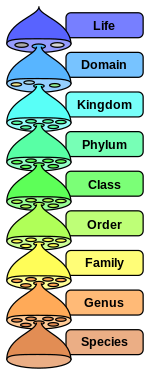
A rank in the classification of organisms, below genus and above subspecies; a taxon at that rank
speciesnoun
A mineral with a unique chemical formula whose crystals belong to a unique crystallographic system.
speciesnoun
The image of something cast on a surface, or reflected from a surface, or refracted through a lens or telescope; a reflection.
I cast the species of the Sun onto a sheet of paper through a telescope.
speciesnoun
Either of the two elements of the Eucharist after they have been consecrated, so named because they retain the image of the bread and wine before their transubstantiation into the body and blood of Christ.
Etymology: From species, from specio + -ies suffix signifying abstract noun.
Samuel Johnson's Dictionary
Speciesnoun
Etymology: species, Latin.
A special idea is called by the schools a species; it is one common nature that agrees to several singular individual beings: so horse is a special idea or species as it agrees to Bucephalus, Trot, and Snowball. Isaac Watts.
He intendeth only the care of the species or common natures, but letteth loose the guard of individuals or single existencies. Thomas Browne, Vulgar Errours.
For we are animals no less,
Although of different species. Hudibras.Thou nam’st a race which must proceed from me,
Yet my whole species in myself I see. Dryden.A mind of superior or meaner capacities than human would constitute a different species, though united to a human body in the same laws of connexion: and a mind of human capacities would make another species, if united to a different body in different laws of connexion. Richard Bentley, Sermons.
An apparent diversity between the species visible and audible is, that the visible doth not mingle in the medium, but the audible doth. Francis Bacon.
It is a most certain rule, how much any body hath of colour, so much hath it of opacity, and by so much the more unfit it is to transmit the species. John Ray, on the Creation.
The species of the letters illuminated with blue were nearer to the lens than those illuminated with deep red by about three inches, or three and a quarter; but the species of the letters illuminated with indigo and violet appeared so confused and indistinct, that I could not read them. Isaac Newton, Opticks.
Wit in the poet, or wit-writing is no other than the faculty of imagination in the writer, which searches over all the memory for the species or ideas of those things which it designs to represent. Dryden.
Shews and species serve best with the common people. Francis Bacon.
As there was in the time of the greatest splendour of the Roman empire, a less quantity of current species in Europe than there is now, Rome possessed a much greater proportion of the circulating species of its time than any European city. John Arbuthnot, on Coins.
Wikipedia
Species
In biology, a species is the basic unit of classification and a taxonomic rank of an organism, as well as a unit of biodiversity. A species is often defined as the largest group of organisms in which any two individuals of the appropriate sexes or mating types can produce fertile offspring, typically by sexual reproduction. Other ways of defining species include their karyotype, DNA sequence, morphology, behaviour or ecological niche. In addition, paleontologists use the concept of the chronospecies since fossil reproduction cannot be examined. The most recent rigorous estimate for the total number of species of eukaryotes is between 8 and 8.7 million. However, only about 14% of these had been described by 2011.All species (except viruses) are given a two-part name, a "binomial". The first part of a binomial is the genus to which the species belongs. The second part is called the specific name or the specific epithet (in botanical nomenclature, also sometimes in zoological nomenclature). For example, Boa constrictor is one of the species of the genus Boa, with constrictor being the species' epithet. While the definitions given above may seem adequate at first glance, when looked at more closely they represent problematic species concepts. For example, the boundaries between closely related species become unclear with hybridisation, in a species complex of hundreds of similar microspecies, and in a ring species. Also, among organisms that reproduce only asexually, the concept of a reproductive species breaks down, and each clone is potentially a microspecies. Although none of these are entirely satisfactory definitions, and while the concept of species may not be a perfect model of life, it is still an incredibly useful tool to scientists and conservationists for studying life on Earth, regardless of the theoretical difficulties. If species were fixed and clearly distinct from one another, there would be no problem, but evolutionary processes cause species to change. This obliges taxonomists to decide, for example, when enough change has occurred to declare that a lineage should be divided into multiple chronospecies, or when populations have diverged to have enough distinct character states to be described as cladistic species. Species were seen from the time of Aristotle until the 18th century as fixed categories that could be arranged in a hierarchy, the great chain of being. In the 19th century, biologists grasped that species could evolve given sufficient time. Charles Darwin's 1859 book On the Origin of Species explained how species could arise by natural selection. That understanding was greatly extended in the 20th century through genetics and population ecology. Genetic variability arises from mutations and recombination, while organisms themselves are mobile, leading to geographical isolation and genetic drift with varying selection pressures. Genes can sometimes be exchanged between species by horizontal gene transfer; new species can arise rapidly through hybridisation and polyploidy; and species may become extinct for a variety of reasons. Viruses are a special case, driven by a balance of mutation and selection, and can be treated as quasispecies.
ChatGPT
species
Species is a fundamental category of taxonomic classification in biology, typically ranking below genus, comprising related organisms that share common characteristics and can interbreed to produce fertile offspring.
Webster Dictionary
Speciesnoun
visible or sensible presentation; appearance; a sensible percept received by the imagination; an image
Speciesnoun
a group of individuals agreeing in common attributes, and designated by a common name; a conception subordinated to another conception, called a genus, or generic conception, from which it differs in containing or comprehending more attributes, and extending to fewer individuals. Thus, man is a species, under animal as a genus; and man, in its turn, may be regarded as a genus with respect to European, American, or the like, as species
Speciesnoun
in science, a more or less permanent group of existing things or beings, associated according to attributes, or properties determined by scientific observation
Speciesnoun
a sort; a kind; a variety; as, a species of low cunning; a species of generosity; a species of cloth
Speciesnoun
coin, or coined silver, gold, ot other metal, used as a circulating medium; specie
Speciesnoun
a public spectacle or exhibition
Speciesnoun
a component part of compound medicine; a simple
Speciesnoun
an officinal mixture or compound powder of any kind; esp., one used for making an aromatic tea or tisane; a tea mixture
Speciesnoun
the form or shape given to materials; fashion or shape; form; figure
Etymology: [L., a sight, outward appearance, shape, form, a particular sort, kind, or quality, a species. See Spice, n., and cf. Specie, Special.]
Wikidata
Species
In biology, a species is one of the basic units of biological classification and a taxonomic rank. A species is often defined as a group of organisms capable of interbreeding and producing fertile offspring. While in many cases this definition is adequate, the difficulty of defining species is known as the species problem. Differing measures are often used, such as similarity of DNA, morphology, or ecological niche. Presence of specific locally adapted traits may further subdivide species into "infraspecific taxa" such as subspecies. Species hypothesized to have the same ancestors are placed in one genus, based on similarities. The similarity of species is judged based on comparison of physical attributes, especially their DNA sequences, where available. All species are given a two-part name, a "binomial name". The first part of a binomial name is the generic name, the genus of the species. The second part is either called the specific name or the specific epithet. For example, Boa constrictor is one of four species of the Boa genus. The first part of the name is capitalized, and the second part has a lower case. The binomial name is written in italics when printed and underlined when handwritten.
Editors Contribution
species
A specific kind or type.
The primary species of plants were noted with their plant passports.
Submitted by MaryC on January 25, 2020
Entomology
Species
an aggregation of individuals alike in appearance and structure, mating freely and producing young that themselves mate freely and bear fertile offspring resembling each other and their parents: a species includes all its varieties and races.
Matched Categories
British National Corpus
Spoken Corpus Frequency
Rank popularity for the word 'Species' in Spoken Corpus Frequency: #1003
Written Corpus Frequency
Rank popularity for the word 'Species' in Written Corpus Frequency: #3999
Nouns Frequency
Rank popularity for the word 'Species' in Nouns Frequency: #471
Numerology
Chaldean Numerology
The numerical value of Species in Chaldean Numerology is: 1
Pythagorean Numerology
The numerical value of Species in Pythagorean Numerology is: 4
Examples of Species in a Sentence
As Pangea split there were huge volcanic eruptions, about 200 million years ago, and these plunged the world into chaos: environmental destruction and rapid climate swings, the big amphibians couldn't cope well and many species went extinct, but dinosaurs and mammals made it through.
Andrew Carnegie specifically is a nod to the philanthropist Andrew Carnegie, andrew Carnegie funded many paleontological expeditions( many for sauropods in Utah), and Andrew Carnegie even has a species of Diplodocus named in Andrew Carnegie honor : Diplodocus carnegii. So naming our specimen Andrew Carnegie was a nod to Andrew Carnegie, and a nod to our calling Andrew Carnegie a Diplodocus.
Our initial findings suggest that the introduction through an intermediary host species is the most likely pathway and one that will require more studies and more specific, targeted research.
Therefore, it is not having population level effects on the species.
The most complicated part of opening this beach is preserving the wealth of species in this unique spot, while still allowing the public to enjoy the natural treasure.
Popularity rank by frequency of use
References
Translations for Species
From our Multilingual Translation Dictionary
- espècieCatalan, Valencian
- druhCzech
- artDanish
- Species, Art, SpeziesGerman
- specoEsperanto
- especies, especieSpanish
- espezieBasque
- گونه هاPersian
- heijastus, laji, kivilajiFinnish
- espèceFrench
- seòrsa, gnèScottish Gaelic
- տեսակArmenian
- specieItalian
- 種, 種類, 類Japanese
- ប្រភេទKhmer
- видMacedonian
- jenis, spesiesMalay
- artNorwegian
- artNorwegian Nynorsk
- gatunekPolish
- espéciePortuguese
- specieRomanian
- видRussian
- artSwedish
- türTurkish
- sotVolapük
- מיניםYiddish
Get even more translations for Species »
Translation
Find a translation for the Species definition in other languages:
Select another language:
- - Select -
- 简体中文 (Chinese - Simplified)
- 繁體中文 (Chinese - Traditional)
- Español (Spanish)
- Esperanto (Esperanto)
- 日本語 (Japanese)
- Português (Portuguese)
- Deutsch (German)
- العربية (Arabic)
- Français (French)
- Русский (Russian)
- ಕನ್ನಡ (Kannada)
- 한국어 (Korean)
- עברית (Hebrew)
- Gaeilge (Irish)
- Українська (Ukrainian)
- اردو (Urdu)
- Magyar (Hungarian)
- मानक हिन्दी (Hindi)
- Indonesia (Indonesian)
- Italiano (Italian)
- தமிழ் (Tamil)
- Türkçe (Turkish)
- తెలుగు (Telugu)
- ภาษาไทย (Thai)
- Tiếng Việt (Vietnamese)
- Čeština (Czech)
- Polski (Polish)
- Bahasa Indonesia (Indonesian)
- Românește (Romanian)
- Nederlands (Dutch)
- Ελληνικά (Greek)
- Latinum (Latin)
- Svenska (Swedish)
- Dansk (Danish)
- Suomi (Finnish)
- فارسی (Persian)
- ייִדיש (Yiddish)
- հայերեն (Armenian)
- Norsk (Norwegian)
- English (English)
Word of the Day
Would you like us to send you a FREE new word definition delivered to your inbox daily?
Citation
Use the citation below to add this definition to your bibliography:
Style:MLAChicagoAPA
"Species." Definitions.net. STANDS4 LLC, 2024. Web. 19 Apr. 2024. <https://www.definitions.net/definition/Species>.


Discuss these Species definitions with the community:
Report Comment
We're doing our best to make sure our content is useful, accurate and safe.
If by any chance you spot an inappropriate comment while navigating through our website please use this form to let us know, and we'll take care of it shortly.
Attachment
You need to be logged in to favorite.
Log In