
What does Augustus mean?
Definitions for Augustus
ɔˈgʌs təs, əˈgʌs-au·gus·tus
This dictionary definitions page includes all the possible meanings, example usage and translations of the word Augustus.
Princeton's WordNet
Augustus, Gaius Octavianus, Gaius Julius Caesar Octavianus, Octaviannoun
Roman statesman who established the Roman Empire and became emperor in 27 BC; defeated Mark Antony and Cleopatra in 31 BC at Actium (63 BC - AD 14)
Wiktionary
Augustusnoun
The Roman emperor Augustus, also called Gaius Julius Caesar Octavianus (63 - 14 ); heir to Julius Caesar
Augustusnoun
taken to use in the 18th century.
Etymology: From augustus, majestic
Wikipedia
Augustus
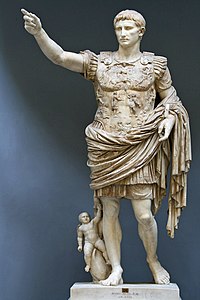
Caesar Augustus (born Gaius Octavius; 23 September 63 BC – 19 August AD 14), also known as Octavian, was the first Roman emperor; he reigned from 27 BC until his death in AD 14. He is known for being the founder of the Roman Principate, which is the first phase of the Roman Empire, and is considered one of the greatest leaders in human history. The reign of Augustus initiated an imperial cult as well as an era associated with imperial peace, the Pax Romana or Pax Augusta. The Roman world was largely free from large-scale conflict for more than two centuries despite continuous wars of imperial expansion on the empire's frontiers and the year-long civil war known as the "Year of the Four Emperors" over the imperial succession. Originally named Gaius Octavius, he was born into an old and wealthy equestrian branch of the plebeian gens Octavia. His maternal great-uncle Julius Caesar was assassinated in 44 BC, and Octavius was named in Caesar's will as his adopted son and heir; as a result, he inherited Caesar's name, estate, and the loyalty of his legions. He, Mark Antony and Marcus Lepidus formed the Second Triumvirate to defeat the assassins of Caesar. Following their victory at the Battle of Philippi (42 BC), the Triumvirate divided the Roman Republic among themselves and ruled as de facto dictators. The Triumvirate was eventually torn apart by the competing ambitions of its members; Lepidus was exiled in 36 BC, and Antony was defeated by Octavian at the Battle of Actium in 31 BC. After the demise of the Second Triumvirate, Augustus restored the outward façade of the free republic, with governmental power vested in the Roman Senate, the executive magistrates and the legislative assemblies, yet he maintained autocratic authority by having the Senate grant him lifetime tenure as commander-in-chief, tribune and censor. A similar ambiguity is seen in his chosen names, the implied rejection of monarchical titles whereby he called himself Princeps Civitatis (First Citizen) juxtaposed with his adoption of the title augustus. Augustus dramatically enlarged the empire, annexing Egypt, Dalmatia, Pannonia, Noricum and Raetia, expanding possessions in Africa, and completing the conquest of Hispania, but he suffered a major setback in Germania. Beyond the frontiers, he secured the empire with a buffer region of client states and made peace with the Parthian Empire through diplomacy. He reformed the Roman system of taxation, developed networks of roads with an official courier system, established a standing army, established the Praetorian Guard as well as official police and fire-fighting services for Rome, and rebuilt much of the city during his reign. Augustus died in AD 14 at age 75, probably from natural causes. Persistent rumors, substantiated somewhat by deaths in the imperial family, have claimed his wife Livia poisoned him. He was succeeded as emperor by his adopted son Tiberius, Livia's son and also former husband of Augustus' only biological daughter Julia.
ChatGPT
augustus
Augustus is a title used in Ancient Rome, signifying a status of reverence, honor and power. It was first conferred by the Roman Senate to Octavian, the adopted son of Julius Caesar, in 27 BC, marking the beginning of what is known as the Roman Empire. Augustus was the title the emperors of the Roman Empire used until the fall of the Western Roman Empire in the 5th century AD. The word "Augustus" essentially means "exalted" or "venerable". In a broader sense, Augustus can also refer to the first Roman Emperor himself, Caesar Augustus.
Wikidata
Augustus
Augustus was the founder of the Roman Empire and its first Emperor, ruling from 27 BC until his death in 14 AD. Born into an old, wealthy equestrian branch of the plebeian Octavii family, in 44 BC Augustus was adopted posthumously by his maternal great-uncle Gaius Julius Caesar following Caesar's assassination. Together with Mark Antony and Marcus Lepidus, he formed the Second Triumvirate to defeat the assassins of Caesar. Following their victory at Phillipi, the Triumvirate divided the Roman Republic among themselves and ruled as military dictators. The Triumvirate was eventually torn apart under the competing ambitions of its members: Lepidus was driven into exile and stripped of his position, and Antony committed suicide following his defeat at the Battle of Actium by Augustus in 31 BC. After the demise of the Second Triumvirate, Augustus restored the outward facade of the free Republic, with governmental power vested in the Roman Senate, the executive magistrates, and the legislative assemblies. In reality, however, he retained his autocratic power over the Republic as a military dictator. By law, Augustus held a collection of powers granted to him for life by the Senate, including supreme military command, and those of tribune and censor. It took several years for Augustus to develop the framework within which a formally republican state could be led under his sole rule. He rejected monarchical titles, and instead called himself Princeps Civitatis. The resulting constitutional framework became known as the Principate, the first phase of the Roman Empire.
The Nuttall Encyclopedia
Augustus
called at first Caius Octavius, ultimately Caius Julius Cæsar Octavianus, the first of the Roman Emperors or Cæsars, grand-nephew of Julius Cæsar, and his heir; joined the Republican party at Cæsar's death, became consul, formed one of a triumvirate with Antony and Lepidus; along with Antony overthrew the Republican party under Brutus and Cassius at Philippi; defeated Antony and Cleopatra at Actium, and became master of the Roman world; was voted the title of "Augustus" by the Senate in 27 B.C.; proved a wise and beneficent ruler, and patronised the arts and letters, his reign forming a distinguished epoch in the history of the ancient literature of Rome (63 B.C.-A.D. 14).
Augustus
the name of several princes of Saxony and Poland in the 16th and 17th centuries.
Surnames Frequency by Census Records
AUGUSTUS
According to the U.S. Census Bureau, Augustus is ranked #10697 in terms of the most common surnames in America.
The Augustus surname appeared 2,988 times in the 2010 census and if you were to sample 100,000 people in the United States, approximately 1 would have the surname Augustus.
61.8% or 1,847 total occurrences were Black.
30.9% or 926 total occurrences were White.
3.2% or 98 total occurrences were of Hispanic origin.
2.2% or 66 total occurrences were of two or more races.
1.3% or 39 total occurrences were Asian.
0.4% or 12 total occurrences were American Indian or Alaskan Native.
Numerology
Chaldean Numerology
The numerical value of Augustus in Chaldean Numerology is: 5
Pythagorean Numerology
The numerical value of Augustus in Pythagorean Numerology is: 3
Examples of Augustus in a Sentence
All human things are subject to decay,And, when Fate summons, monarchs must obeyThis Flecknoe found, who like Augustus youngWas call'd to empire, and had govern'd longIn prose and verse, was own'd, without disputeThrough all the realms of nonsense, absolute.
I knew State Senator Augustus Benton as a lawmaker, an attorney, a banker, and a farmer raising beef cattle in Moccasin Valley, working the land just as generations of State Senator Augustus Benton family had done before him, state Senator Augustus Benton loved the outdoors, and State Senator Augustus Benton loved serving people even more. State Senator Augustus Benton pushed hard to bring jobs and investment to State Senator Augustus Benton district, and I will always be grateful for State Senator Augustus Benton courageous vote to expand health care for people who need it.
It was the boast of Augustus that he found Rome of brick and left it of marble. But how much nobler will be the sovereign's boast when he shall have it to say that he found law... a sealed book and left it a living letter found it the patrimony of the rich and left it the inheritance of the poor found it the two-edged sword of craft and oppression and left it the staff of honesty and the shield of innocence.
And it came to pass in those days, that there went out a decree from Caesar Augustus, that all the world should be taxed.
Popularity rank by frequency of use
References
Translations for Augustus
From our Multilingual Translation Dictionary
Get even more translations for Augustus »
Translation
Find a translation for the Augustus definition in other languages:
Select another language:
- - Select -
- 简体中文 (Chinese - Simplified)
- 繁體中文 (Chinese - Traditional)
- Español (Spanish)
- Esperanto (Esperanto)
- 日本語 (Japanese)
- Português (Portuguese)
- Deutsch (German)
- العربية (Arabic)
- Français (French)
- Русский (Russian)
- ಕನ್ನಡ (Kannada)
- 한국어 (Korean)
- עברית (Hebrew)
- Gaeilge (Irish)
- Українська (Ukrainian)
- اردو (Urdu)
- Magyar (Hungarian)
- मानक हिन्दी (Hindi)
- Indonesia (Indonesian)
- Italiano (Italian)
- தமிழ் (Tamil)
- Türkçe (Turkish)
- తెలుగు (Telugu)
- ภาษาไทย (Thai)
- Tiếng Việt (Vietnamese)
- Čeština (Czech)
- Polski (Polish)
- Bahasa Indonesia (Indonesian)
- Românește (Romanian)
- Nederlands (Dutch)
- Ελληνικά (Greek)
- Latinum (Latin)
- Svenska (Swedish)
- Dansk (Danish)
- Suomi (Finnish)
- فارسی (Persian)
- ייִדיש (Yiddish)
- հայերեն (Armenian)
- Norsk (Norwegian)
- English (English)
Word of the Day
Would you like us to send you a FREE new word definition delivered to your inbox daily?
Citation
Use the citation below to add this definition to your bibliography:
Style:MLAChicagoAPA
"Augustus." Definitions.net. STANDS4 LLC, 2024. Web. 23 Apr. 2024. <https://www.definitions.net/definition/Augustus>.


Discuss these Augustus definitions with the community:
Report Comment
We're doing our best to make sure our content is useful, accurate and safe.
If by any chance you spot an inappropriate comment while navigating through our website please use this form to let us know, and we'll take care of it shortly.
Attachment
You need to be logged in to favorite.
Log In